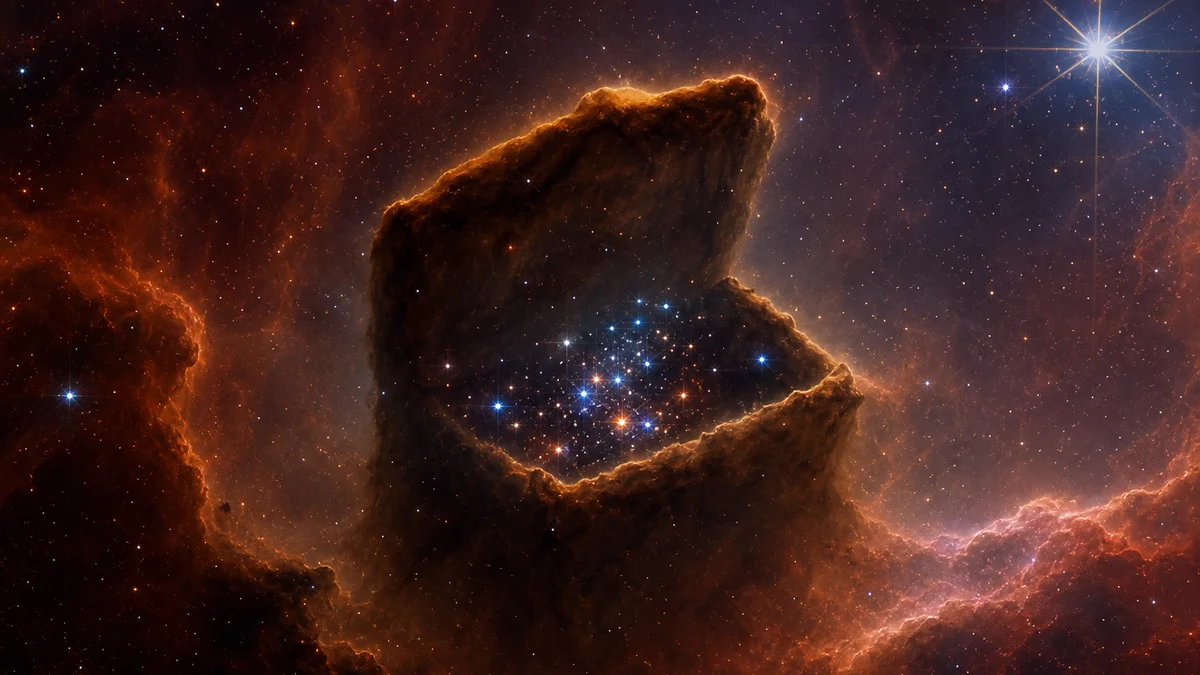
Short answer: NASA's Astronomy Picture of the Day for September 17, 2026 shows a pillar of gas and dust in the Carina Nebula, about 7,500 light-years away, carved by stellar winds and radiation into the shape of an open treasure chest. Tucked inside it is a compact cluster of roughly 70 stars, thought to be only around 1.3 million years old — including one star weighing in at about 19 times the mass of our Sun. The whole structure sits under the influence of Eta Carinae, a nearby star more luminous than 5 million Suns.
What is actually glowing inside this "chest"?
The image was captured by the James Webb Space Telescope, which sees in infrared — light that slices through the dust clouds that would block a normal visible-light camera. What it caught is a dense pillar of interstellar gas and dust, sculpted from the outside by powerful stellar winds and radiation pouring out of neighboring stars. According to NASA's explanation, the star formation happening inside the pillar itself is "excavating its head," hollowing it out from within at the same time it's being eaten away from without. That double pressure — carved from outside and hollowed from inside — is what gives the structure its open, lid-like shape.
Why does one star's mass decide the whole picture?
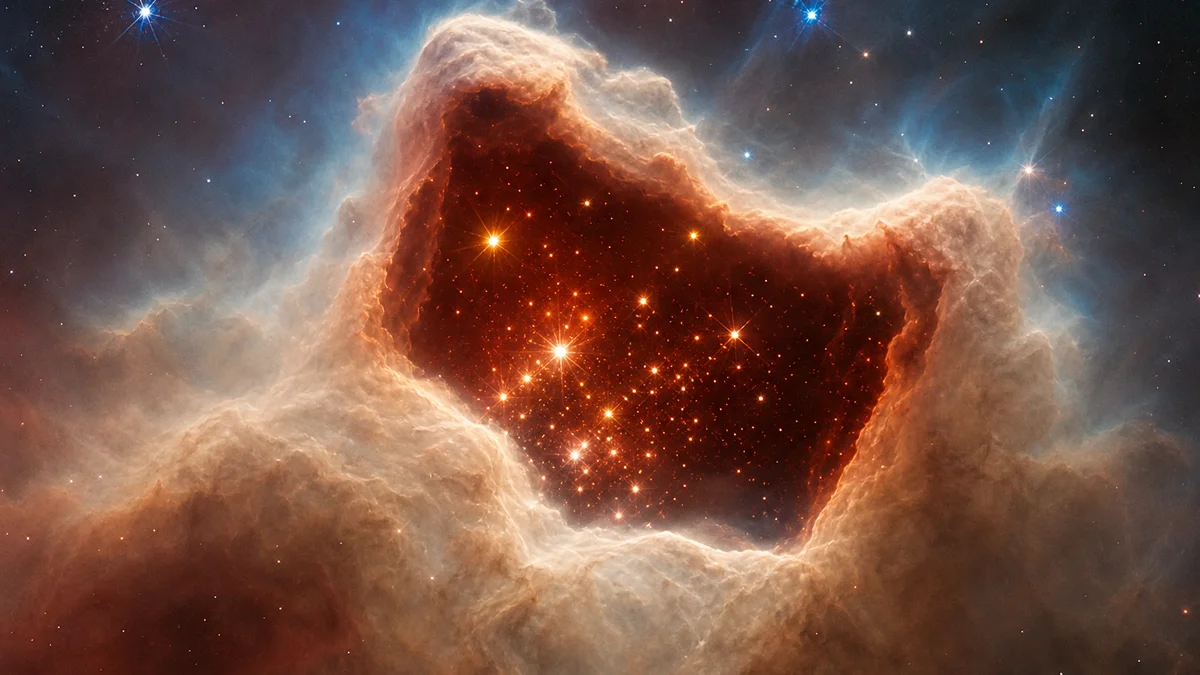
The most massive star found in that cluster is about 19 times heavier than the Sun. That single number matters more than it sounds like it should, because a star's mass is the one variable that sets almost everything else about its life: how brightly it shines, how hot it burns, and how long it lasts. Massive stars burn through their nuclear fuel far faster than small ones, which is why NASA's own description calls them "rarer" and says they "shine brighter and evolve faster than less massive stars" — the shiniest jewels in the chest, and also the ones that will burn out soonest.
Our Sun is a useful yardstick precisely because it sits on the calm end of that scale. It has been fusing hydrogen steadily for roughly 4.6 billion years and has billions more ahead of it. A star 19 times more massive doesn't get that kind of patience: stars in that range typically live only a few million years before exhausting their core fuel, collapsing, and ending in a supernova. The cluster in this image, at just 1.3 million years old, is essentially watching that fast clock tick from its very first moments.
Putting the numbers side by side
| Object | Mass vs. the Sun | Rough lifespan | Fate | |---|---|---|---| | Our Sun | 1× | ~10 billion years total | Slow fade into a white dwarf | | Massive star in the pillar | ~19× | A few million years | Core collapse, likely supernova | | Eta Carinae | Tens of solar masses | Very short | Already unstable; expected to end violently |
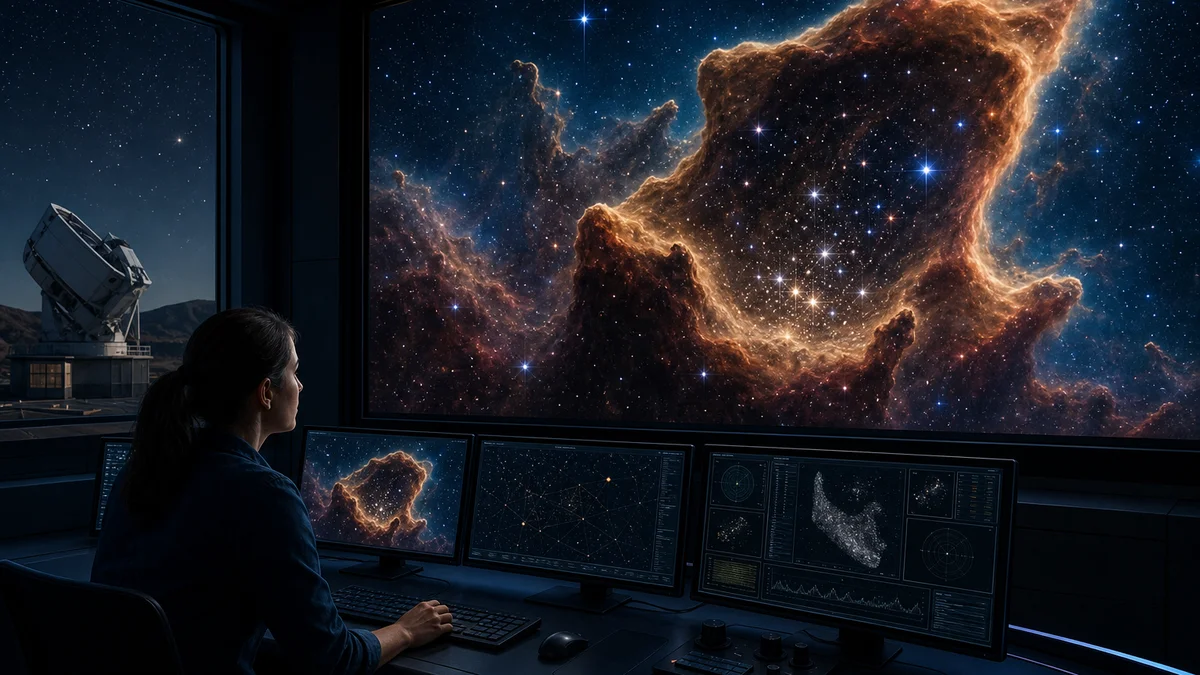
Eta Carinae is the extreme end of this same story. It doesn't just outshine the Sun — NASA describes it as "more luminous than 5 million suns," and its radiation and stellar winds are a major force sculpting the pillar's shape from outside. It's a preview of what the pillar's own massive star may become on a much larger scale, and a reminder that the same physics governing our stable, steady Sun applies — just turned up to an extreme most stars never reach.
A chest that keeps opening
The most striking part of this image isn't just what it shows, but that it's still happening. The pillar isn't a static monument; it's an active construction site, being reshaped in real time by the very stars being born inside it. Every few hundred thousand years, more of the "lid" gets excavated, more of the cluster's stars finish forming, and the balance between outside pressure and inside star formation shifts again.
A different kind of stellar neighborhood
It's worth remembering, looking at a scene like this, how ordinary our own solar system's star really is by comparison. On the real-time 3D simulator at Solar System Live, the Sun you see is the same kind of slow, stable, middle-of-the-road star that will keep shining calmly for billions more years — nothing like the short, violent lives of the giants being forged inside Carina's treasure chest right now.