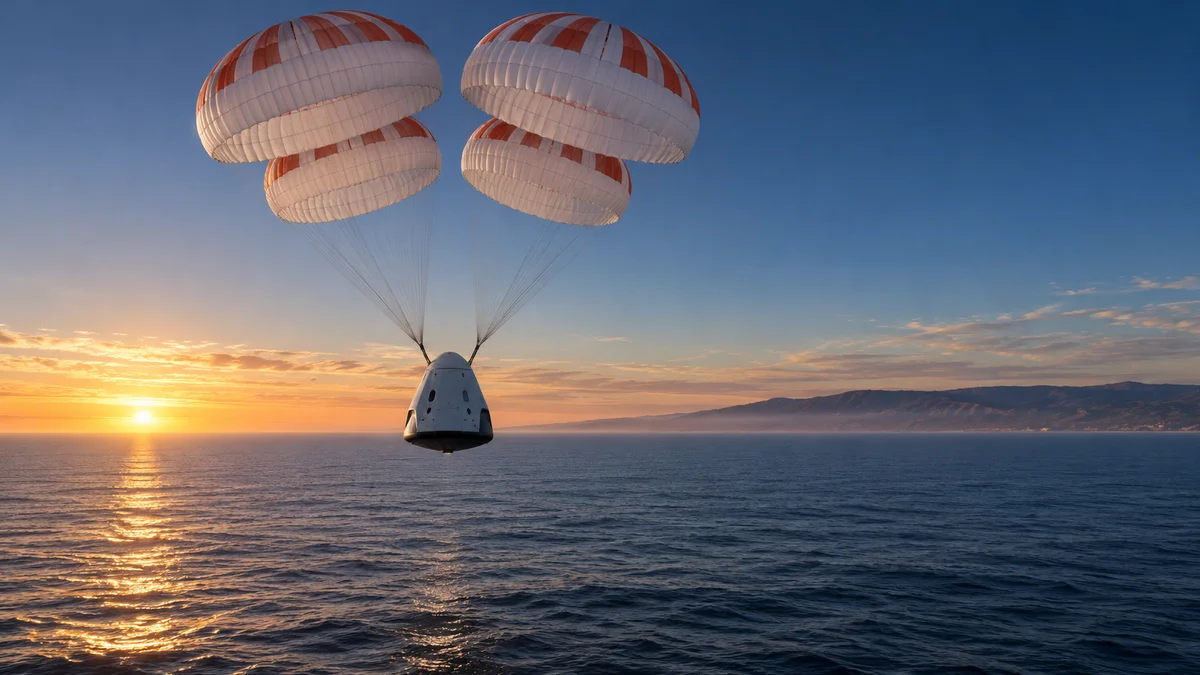
Crew-12 has returned to Earth after spending nearly eight months aboard the International Space Station. The crew’s SpaceX Dragon capsule splashed down in the Pacific Ocean off California on October 8, 2026, according to NASA.
The useful story in the landing photograph is not simply that four people are home. It is a compact view of the end of a journey between two very different environments: an orbiting laboratory and the surface of our planet. Reading the image carefully also means noticing what it leaves unanswered.
What does NASA’s splashdown photo show?
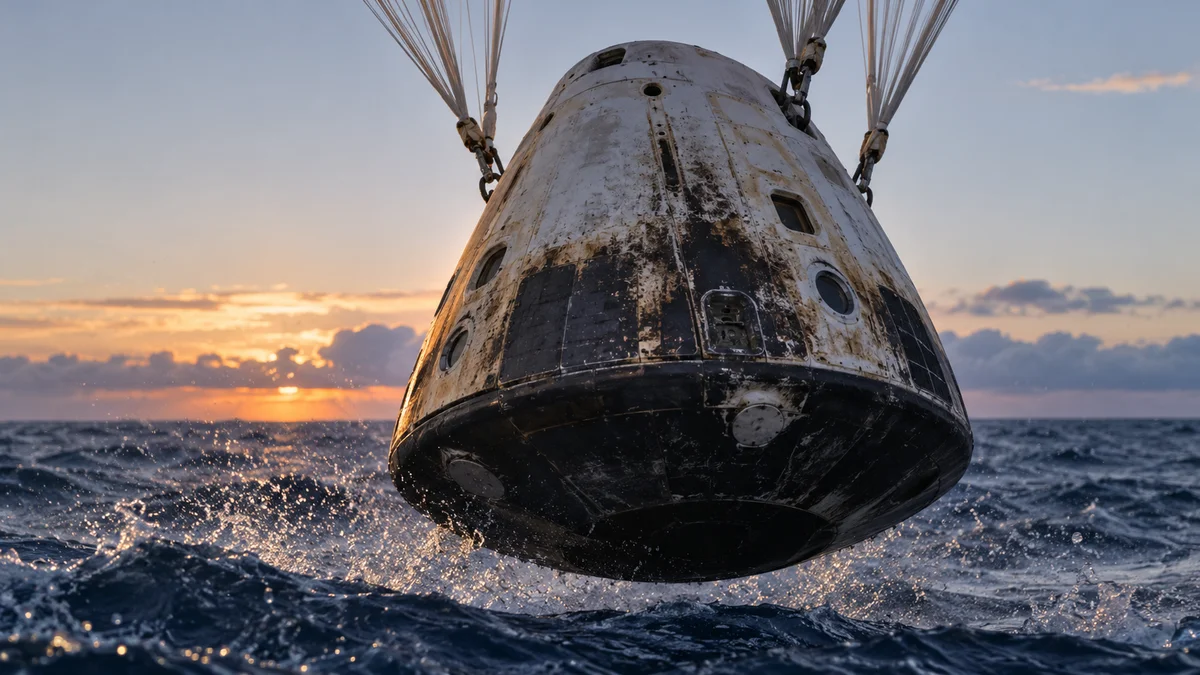
NASA’s image captures the Crew Dragon Freedom moments before it splashed down. The capsule was carrying NASA astronauts Jessica Meir and Jack Hathaway, European Space Agency astronaut Sophie Adenot, and Roscosmos cosmonaut Andrey Fedyaev.
The frame marks a transition point. The spacecraft is still above the Pacific, just before meeting the ocean. NASA’s caption places the landing off California and dates the photograph to October 8, 2026. It also says the four crew members had spent nearly eight months aboard the International Space Station.
| What the caption establishes | What it tells us | |---|---| | Capsule: Crew Dragon Freedom | The spacecraft shown in the landing moment | | Crew: Meir, Hathaway, Adenot, and Fedyaev | The four people aboard | | Location: Pacific Ocean off California | Where the splashdown took place | | Photograph date: October 8, 2026 | When this moment was recorded | | Time aboard the station: nearly eight months | The length of this crew’s stay, as stated by NASA |
This small evidence table is a practical way to separate caption facts from assumptions prompted by the image. The photograph does not, by itself, show the full descent, the spacecraft’s route, or the crew’s work in orbit.
Why is returning from the station a journey, not just a landing?
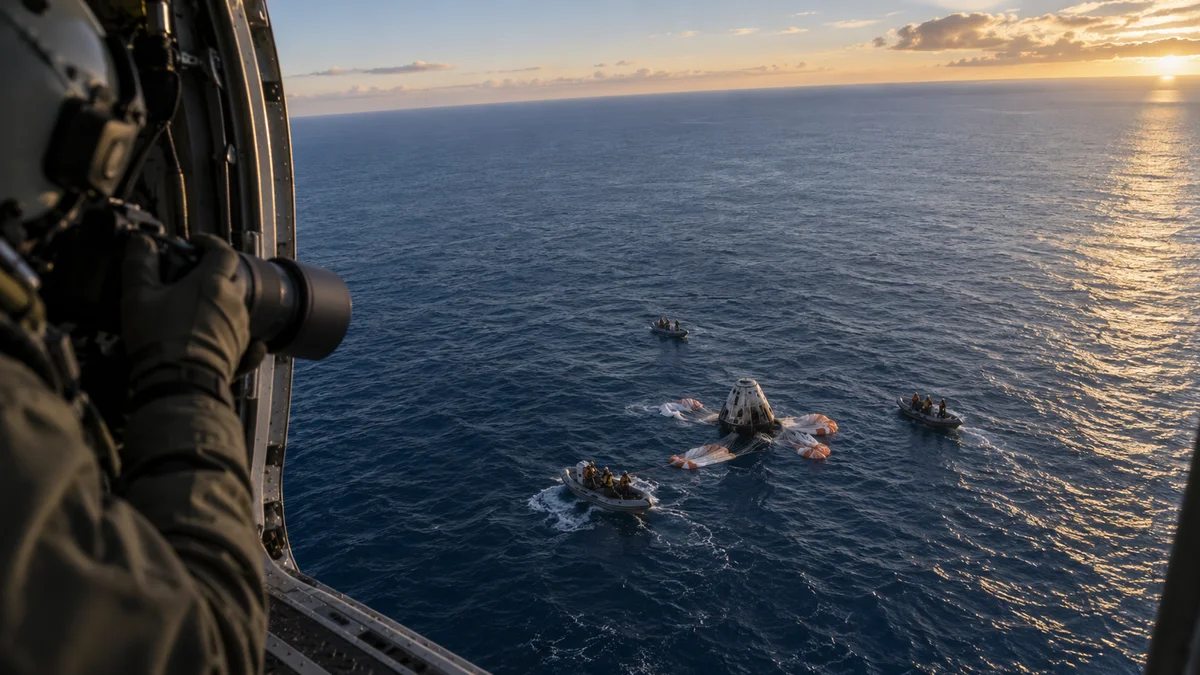
The International Space Station is an orbital workplace, while the landing happens at Earth’s surface. A return therefore has two parts worth keeping distinct: leaving the station’s orbiting environment and arriving at a landing area. NASA’s image documents the final part of that sequence, the capsule moments before ocean contact.
The photograph should not be mistaken for a complete mission timeline. NASA’s caption confirms the landing location and the time the crew spent aboard the station, but this image article does not provide a detailed account of each step between departure and splashdown. Staying within what the source says makes the picture more useful, not less: it lets us identify precisely which instant we are seeing.
What can we infer from a capsule just above the water?
We can identify a spacecraft at the threshold of splashdown and connect it to a named crew and a location. We can also understand that returning from a long stay in orbit culminates in a very earthly scene: a capsule approaching the Pacific. But the image does not tell us the astronauts’ physical condition, the capsule’s speed, or the technical results of the landing.
That boundary matters whenever a dramatic photograph becomes a news hook. A single frame is strong evidence for the moment it depicts, but it is not a substitute for a full mission report. NASA’s caption supplies a few essential coordinates—who, where, when, and how long aboard the station. It does not claim to answer every question a viewer might ask.
How does this return connect to the solar system?
The station is in Earth orbit, so this story happens close to home on a solar-system scale. The capsule’s return is not an interplanetary voyage: the destination is Earth, and the Pacific splashdown is the final scene described in NASA’s account.
That perspective helps place human spaceflight alongside the larger motions shown in a solar-system simulator. The planets travel around the Sun; Crew-12’s reported journey instead concerns people working in orbit around Earth and then coming back to its surface. These are different scales of movement, but both become easier to picture when we ask where an object is and how its position changes.
Solar System Live focuses on the Sun and planets, so it does not show the Crew Dragon or the station’s detailed orbit. It can still provide a useful next step for orientation: look at Earth in the context of its solar-system neighbours, then return to NASA’s photograph and focus on the capsule’s much shorter final approach.
What should you take away from the image?
NASA’s caption gives a concise record: four astronauts aboard Freedom, a Pacific landing off California on October 8, and nearly eight months spent at the station. The image freezes the spacecraft just before splashdown, at the boundary between an orbital mission and a return to Earth.
To explore the moment, open NASA’s Crew-12 splashdown image and caption. Read the caption first, identify what it directly confirms, and then look at the frame again. That simple sequence helps keep the human story vivid while leaving technical details to sources that actually provide them.