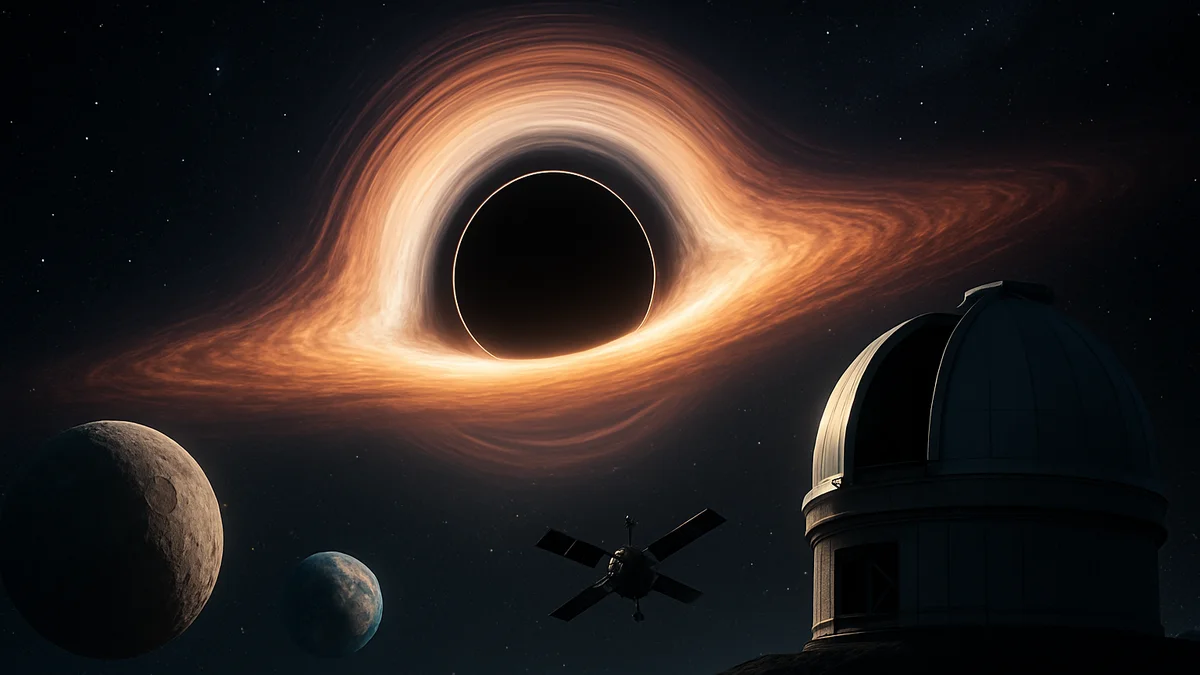
A black hole is, in principle, the simplest object in the universe. Strip away everything that fell into it — planets, stars, gas, magnetic fields, whatever complicated history it had — and what's left can supposedly be described with just three numbers: its mass, its spin, and its electric charge. Physicists call this idea the "no-hair theorem": no matter how much detail a black hole swallows, it grows no distinguishing features, no "hair," beyond those three properties. According to a report from Phys.org on September 7, 2026, scientists have identified a new way to check whether that assumption actually holds.
What does it mean for a black hole to have "hair"?
The term comes from physicist John Wheeler, who is credited with the phrase "black holes have no hair" back in the 1970s. The idea was startling at the time: an object as extreme as a collapsed star should, by any intuition, carry some imprint of what it was made from and how it formed. Instead, general relativity predicts the opposite. Once an event horizon forms, all the information about the infalling matter's shape, composition, and structure is expected to vanish from the outside observer's point of view, leaving behind a featureless, mathematically clean object.
This isn't just an elegant simplification — it's a strong, falsifiable prediction. If black holes turn out to have extra properties beyond mass, spin, and charge, that would mean general relativity itself is incomplete in the regime of the strongest gravity we know.
Why this is hard to check
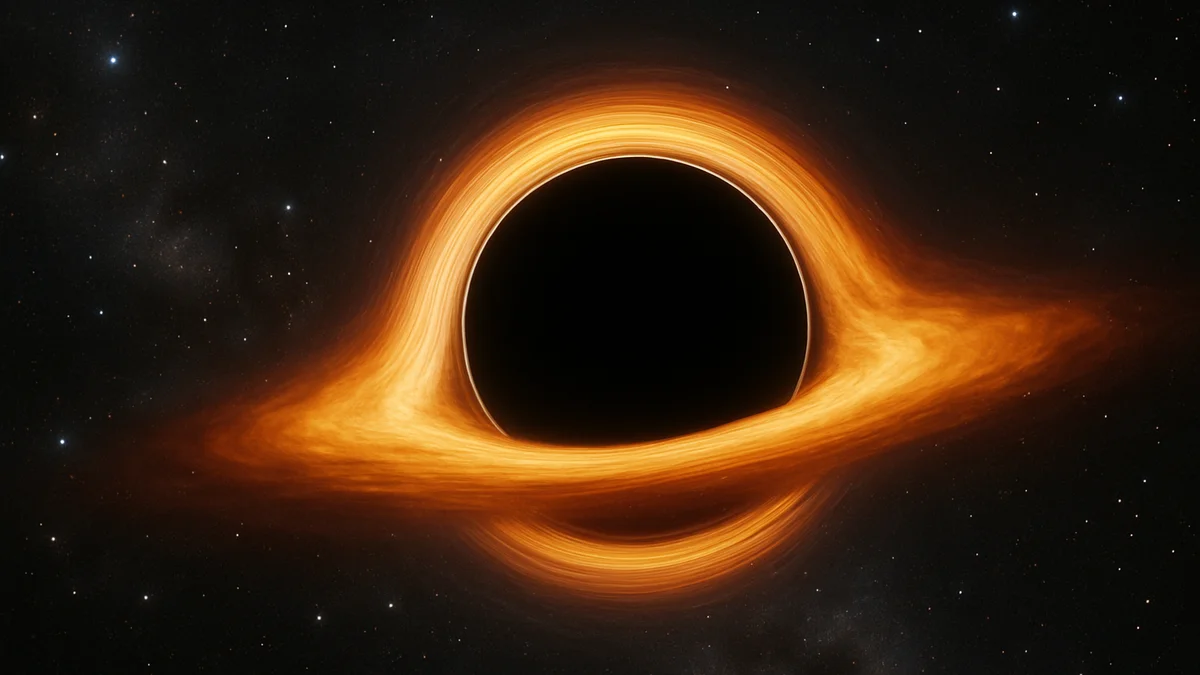
You cannot point a telescope at a black hole and read off its properties directly; it emits no light of its own. What astronomers actually observe is the effect a black hole has on its surroundings — the way light bends around it, the way matter swirls and heats up before crossing the horizon, or, most precisely, the way spacetime itself rings after two black holes collide and merge.
That last case is where the most sensitive tests come from. When gravitational-wave observatories detect a merger, the newly formed black hole doesn't settle down instantly — it "rings," much like a struck bell, radiating away its distortions as gravitational waves before settling into the smooth, hairless state the theorem predicts. If the no-hair theorem is correct, the frequencies of that ringing should follow a strict, predictable pattern tied only to the final mass and spin. Any extra note in that ringing — any deviation from the expected pattern — would be a hint of the "hidden hair" the report is asking about.
The same gravity, tested at very different scales
It's worth remembering that general relativity, the theory behind the no-hair prediction, was first confirmed much closer to home. The tiny, otherwise unexplained drift in Mercury's orbit around the Sun — an extra 43 arcseconds of precession per century that Newtonian gravity couldn't account for — was one of the earliest and most convincing pieces of evidence for Einstein's theory. GPS satellites orbiting Earth today still have to correct for relativistic time dilation to stay accurate, another everyday confirmation of the same physics.
Black holes push that same theory into a regime our solar system never comes close to: gravity strong enough to trap light itself. Testing the no-hair theorem is really asking whether the equations that correctly predict a subtle wobble in Mercury's orbit still hold when gravity is pushed to its absolute limit. So far, every test — from the first imaged black hole shadow to the ringdown signals captured by gravitational-wave detectors — has been consistent with Einstein's prediction of a bald, simple black hole. A new, more sensitive way to check only sharpens that test.
Why it matters going forward
If a discrepancy is ever found, it wouldn't just be a footnote for black hole researchers — it would point toward physics beyond general relativity, the same theory that also governs how planets, moons, and spacecraft move throughout our own solar system. Every new method for listening to black holes ring, or watching them cast shadows, is really another attempt to find the edge where our best theory of gravity might start to break down. Right now, the black holes we've observed still look remarkably, stubbornly bald.