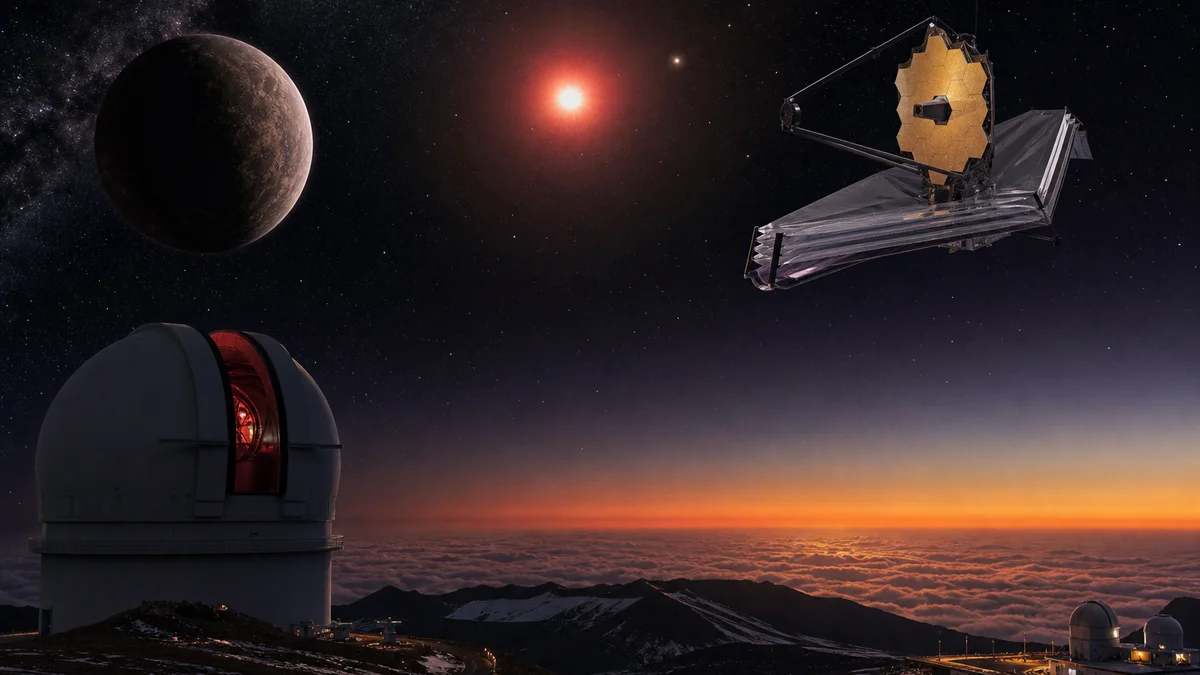
A rocky planet orbiting a faint red star just produced one of the more careful "maybe" results in recent exoplanet news. One James Webb Space Telescope observation of LHS 1140b picked up a hint of helium gas escaping its atmosphere; a second observation of the same planet did not show it. That contradiction, not a confirmed discovery, is the actual state of the data as of late September 2026.
What LHS 1140b actually is
LHS 1140b was discovered in 2017 and orbits LHS 1140, a red dwarf star in the constellation Cetus. The star is about one-fifth the mass of our Sun and roughly 300 times fainter — dim enough that Phys.org describes it as 10,000 times fainter than the faintest star visible to the naked eye. The planet itself is 1.7 times Earth's radius and just over five times Earth's mass, sitting in the star's habitable zone, the distance range where surface liquid water is physically possible. Earlier JWST observations had already ruled out a hydrogen-rich atmosphere, which is what made a new signal worth checking at all.
Why "helium escaping" is the detail that matters
The new findings, published by Collin Cherubim and colleagues in Science in 2026, describe a possible secondary atmosphere — one built from gases released by the planet's interior or chemistry over time, rather than the primordial hydrogen and helium a planet captures straight from the disk it formed in. Secondary atmospheres are the kind that can persist long enough to be studied in detail, which is why researchers treat the result as worth pursuing even though the second observation didn't reproduce it. The equilibrium temperature estimate for the planet also depends heavily on modeling choices: published figures range from about -30°C to -90°C, and Phys.org's own reporting flags "significant, untested assumptions" behind that range.
The part this news doesn't have to explain: we already have secondary atmospheres next door
Here's where a planetary simulator earns its keep. A "secondary atmosphere" isn't a hypothetical category invented for one distant planet — it's the normal outcome for small, rocky worlds, and the Solar System has the examples sitting in plain view. Venus lost whatever atmosphere it started with early on and now carries a dense secondary one, built mostly of carbon dioxide released from its own interior. Mars did the same on a much thinner scale, holding on to a wisp of a secondary CO2 atmosphere after its original air escaped to space. Titan, Saturn's largest moon, built a secondary nitrogen-based atmosphere thick enough to support weather. None of them prove LHS 1140b has life, or even confirm its helium signal — but they are the working, nearby answer to "what would a secondary atmosphere even look like," available to explore right now in the 3D solar system simulator, rather than waiting on a telescope 48 trillion kilometers away.
Why the contradiction isn't a failure
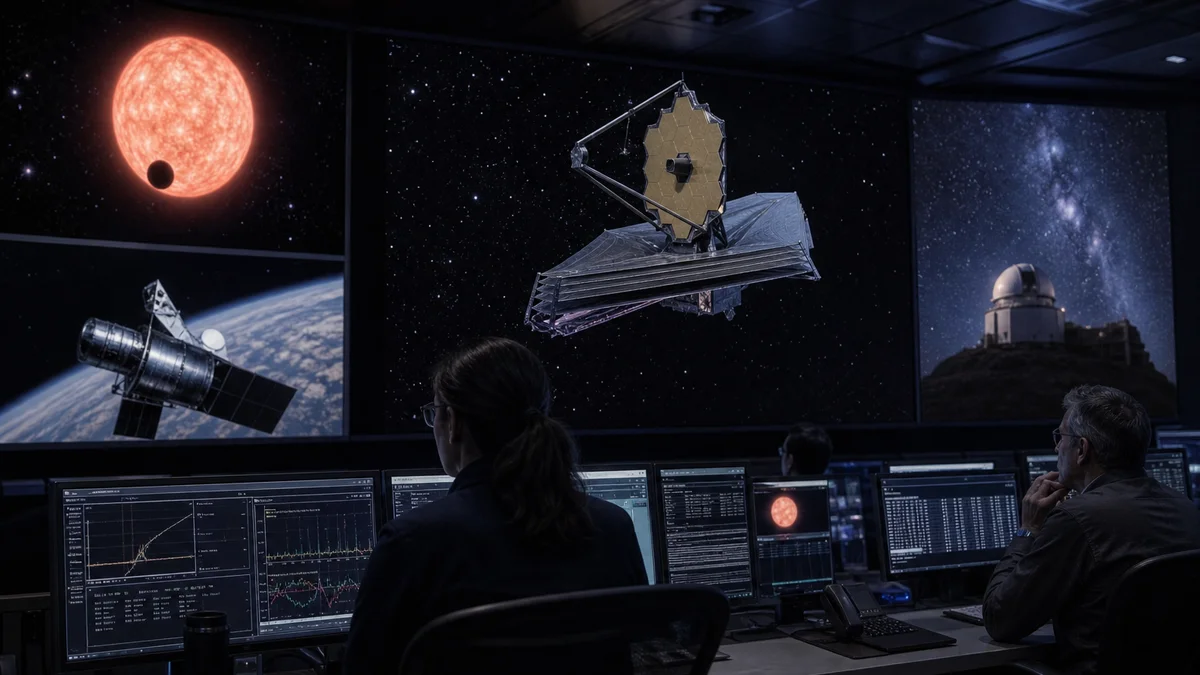
A single faint detection followed by a non-detection is a normal, unglamorous moment in exoplanet science, not a retraction. Helium escaping an atmosphere produces a weak signal to begin with, and distinguishing a real but marginal trace from instrument noise usually takes several independent looks — exactly the process now underway. Treating "we're not sure yet" as the headline, rather than either "confirmed" or "debunked," is the honest read of where this result actually stands.
What to watch next
The next useful update on LHS 1140b will be a third observation, aimed specifically at resolving the disagreement between the first two. Until then, the planet's status is best described as "atmosphere under investigation," with hydrogen already excluded and helium neither confirmed nor ruled out. For a hands-on sense of why that distinction matters, compare Venus, Mars and Earth's own very different atmospheric histories in the simulator — the same physics that shaped them is what's being tested, at much greater distance, around LHS 1140.