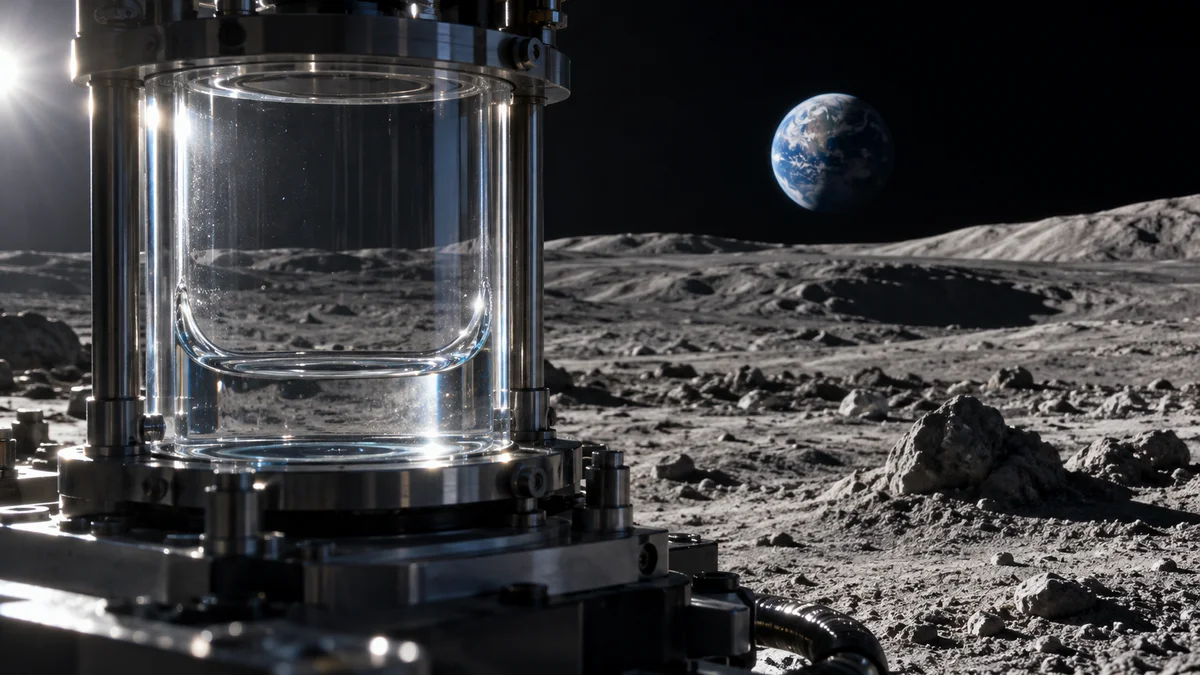
Liquid water under lunar gravity would still respond to gravity, but its contact with a container or growing medium matters greatly. In a recent flight experiment, liquid surfaces were rounder and liquid climbed higher along test-chamber walls than under Earth gravity. The experiment did not establish how water flows through actual lunar soil.
That distinction answers two questions often folded into “water on the Moon.” NASA reports water molecules and ice on the Moon; the new research paper asks how supplied liquid might behave in a future plant-growing system. Finding water on a world and delivering it reliably to roots are different problems.
What did the flight experiment actually show?
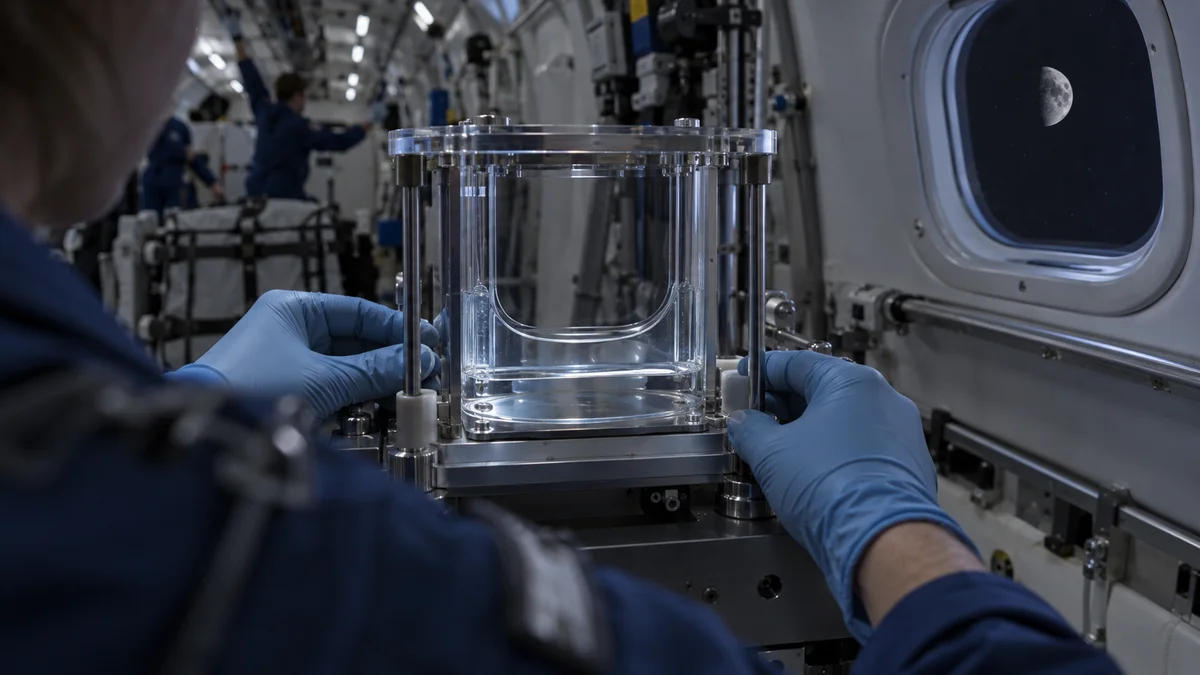
The researchers placed deionized water, a glycerol solution and a saline solution in a chamber with differently angled walls. During a New Shepard flight, rotation of the capsule produced an acceleration close to lunar gravity. The team photographed the curved liquid surfaces, called menisci, and compared them with Earth-gravity controls.
The published study reports an average flight acceleration of 1.76 metres per second squared for 2.3 minutes. It also gives the Moon’s actual surface gravity as 1.625 metres per second squared: the simulated value was about 8% higher. This was a useful test near lunar gravity, not an experiment conducted on the lunar surface.
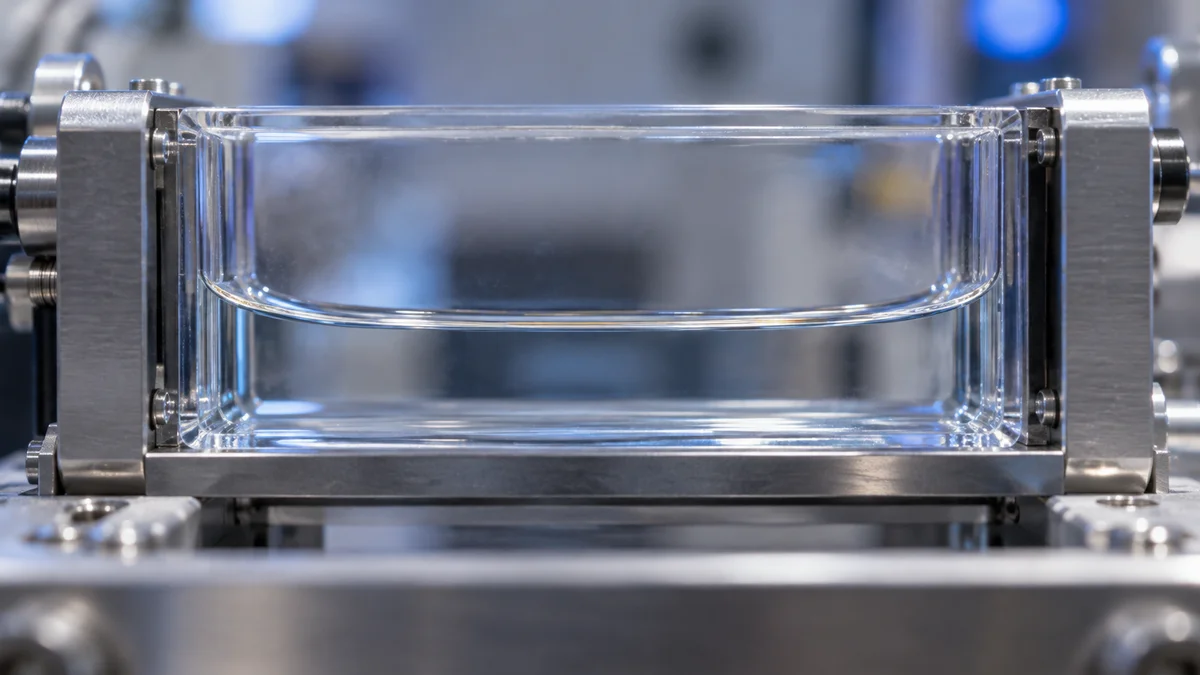
With the same volume of liquid, the lower-acceleration images showed rounder surfaces and higher liquid columns than the Earth-gravity images. The researchers attribute the height difference to thicker films along the chamber surfaces. The result makes the wall part of the story: “How does water move?” cannot be answered from gravity alone.
| Setting | What we can examine | What it cannot tell us | |---|---|---| | Solar System Live’s Moon view | Where the Moon sits in relation to Earth and the Sun | How liquid moves across its surface or through soil | | Flight test chamber | Liquid surfaces and their interaction with particular walls near lunar gravity | Flow through a real lunar planting bed | | Future regolith growing system | The practical question: whether water reaches roots while leaving them aerated | Its performance until that system is tested |
Why doesn’t this mean lunar soil is ready for watering?
The liquids touched manufactured chamber walls, not lunar regolith. The study says the roughness of its printed chamber, uncertain wall interactions and a leak limited the strength of some measurements. Its authors specifically call for studies of water movement and wetting in the presence of regolith.
That matters for plants. A growing system must distribute water without leaving roots short of air. NASA’s Plant Water Management research treats wetting, surface tension and system shape as tools for providing both hydration and aeration in reduced gravity. The flight experiment contributes evidence about liquid and surface interactions; it is not a working lunar garden.
The glycerol mixture showed enhanced wetting in this experiment. That is a reason to investigate possible additives, not proof that adding glycerol will solve irrigation in lunar soil. The paper itself presents further testing as necessary.
Isn’t there already water on the Moon?
Yes, but it is important to name its form and setting. NASA’s Moon facts describe water ice in permanently shadowed polar regions and water molecules detected on the sunlit surface. NASA also says the Moon lacks the liquid surface water familiar on Earth.
The flight study therefore does not show a lunar stream, puddle or naturally watered field. Its question concerns liquid introduced into a controlled system. A reader looking for lunar water should keep three separate ideas in view: where water has been detected, how an added liquid behaves under weak gravity, and whether a future growing medium can deliver that liquid to plants.
What can the simulator add?
Solar System Live gives the experiment a location. Open the 3D simulator, find the Moon beside Earth, and follow the larger Earth–Moon–Sun arrangement. For another way to explore that geometry, see our articles on the Moon’s shadow during a solar eclipse and a daytime lunar occultation of Venus.
Then return to the research paper’s comparison of the liquid surfaces. The simulator places the Moon in the solar system; the chamber images address a much smaller question about liquid against a wall. Reading both at their proper scale is the next step toward understanding what “water on the Moon” means.