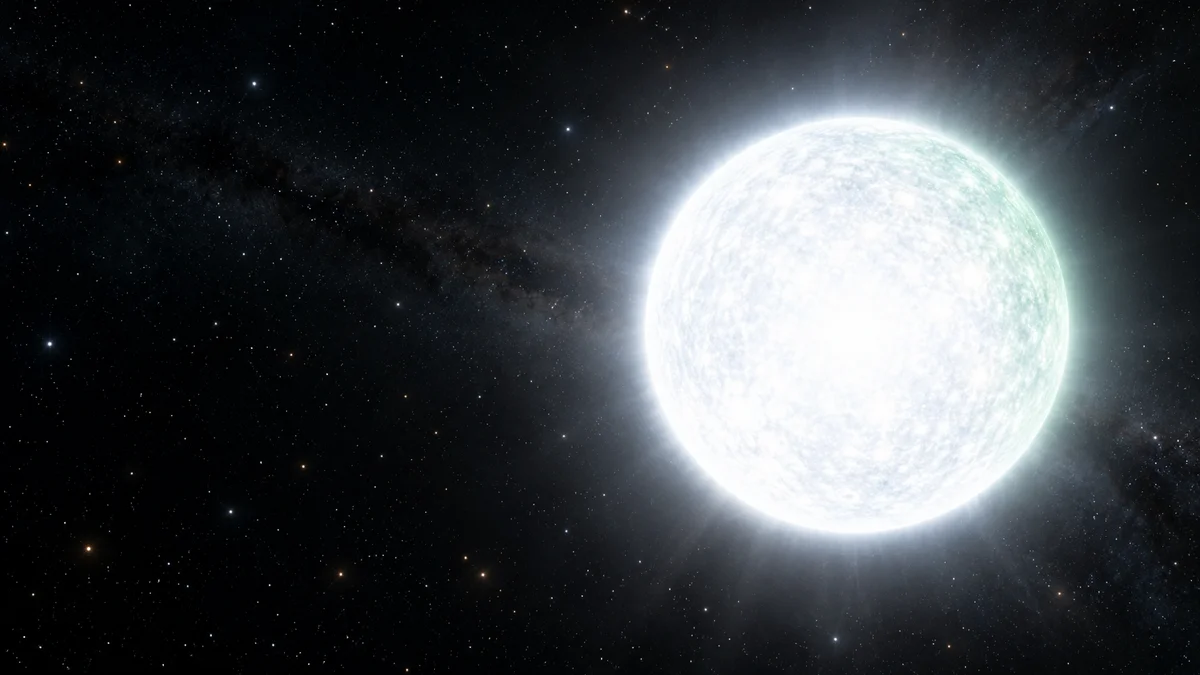
Some white dwarfs would look green, pink or purple if we could see their discs up close. Most still look white, and the new research does not predict the color of the Sun’s future remnant. That is the useful distinction when a story about distant stars appears beside a simulator of our present Solar System.
The published study calculates how human eyes would perceive light from white dwarfs with different atmospheres. NASA explains that the Sun will eventually become a white dwarf. Put those findings together carefully: the first describes a range of other stellar remnants; the second describes a stage awaiting our star.
Are white dwarfs really white?
Usually, yes. The researchers examined a distance-limited sample of 152 white dwarfs within 20 parsecs of the Sun. Five lay clearly away from the usual color pattern: two appeared yellow in the calculations and three pink. For the rest, the median calculated color temperature was about 6,800 kelvin, corresponding to a near-white appearance. These figures come from the paper’s local-sample analysis.
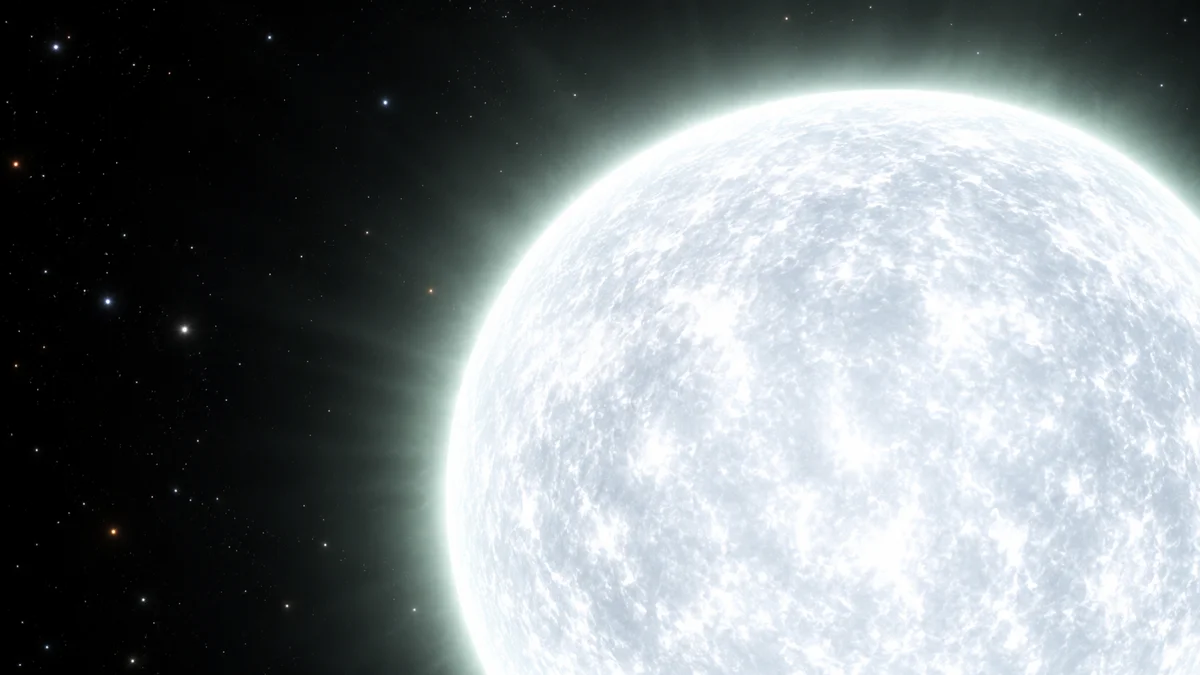
“White dwarf” names a kind of stellar remnant, not a guarantee about every individual star’s color. Likewise, an illustration tinted blue or green is not a direct photograph of a disc seen by a human observer. The team worked from spectra and atmosphere models, then calculated perceived colors. No white dwarf is close enough for us to inspect its colored disc by eye, as the University of Warwick’s account of the research makes clear.
Where do the unusual colors come from?
Temperature matters, but a dense atmosphere can remove particular parts of the visible light before it reaches an observer. The paper links pink and purple examples to carbon-bearing atmospheres. In some cool white dwarfs, elements delivered by rocky debris affect the spectrum: the authors identify yellow examples and calculate a green appearance for WD J1330+6435.
That green result deserves its qualification. The researchers report that this star’s spectrum is somewhat noisy, so its exact calculated color could differ. Their work offers a physical explanation for a green appearance; it does not report somebody looking through a telescope and seeing a green stellar disc.
| Reference | What we can say | What we cannot infer | |---|---|---| | The Sun in Solar System Live | It is the star at the center of the planetary system shown today. | The simulator does not display its future white-dwarf atmosphere. | | Nearby white dwarfs in the study | Most of the sample have a near-white calculated appearance. | Their median color is not a forecast for the Sun. | | WD J1330+6435 | Its modeled light gives a green appearance linked to atmospheric absorption. | It does not show that every white dwarf, or the Sun’s remnant, will be green. | | Pink examples | Carbon in their atmospheres changes their calculated colors. | Pink is not the inevitable color of a cooling star. |
What does this tell us about the Solar System’s future?
NASA’s guide to star types describes the sequence: the Sun will become a red giant, shed its outer atmosphere and leave a white dwarf. A white dwarf is therefore relevant to the Solar System’s future, even though Solar System Live shows the Sun and planets as a present-day planetary system.
The color study does not trace the Sun through those stages or calculate the chemistry of its eventual remnant. It would be tempting to take the green example and paint a future Solar System around it. The evidence supports a narrower reading: unusual colors can reveal what is present in particular white-dwarf atmospheres, including traces associated with planetary debris. It does not assign that history to our Sun.
That atmospheric clue connects with our article on a possible second-generation planet around a white dwarf. Both stories use a remnant star’s light to investigate material around it, but they ask different questions: one concerns perceived color; the other concerns evidence for a planet candidate. Our close look at comet 67P offers a separate view of a small body in our own Solar System, without implying that 67P supplied material to any star in this study.
Open Solar System Live and locate the Sun. Then compare that present-day view with the paper’s color examples. The question to keep in mind is precise: whose atmosphere produced the color?