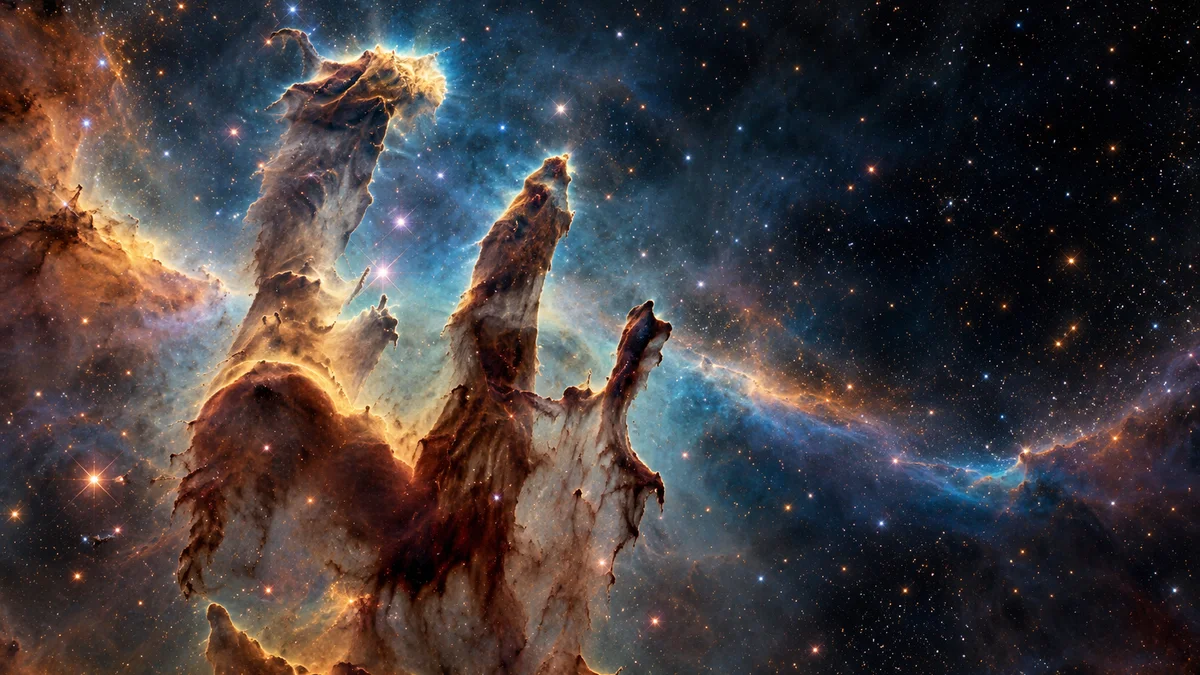
The Pillars of Creation sound is a translation of telescope images into audio, not a recording made beside the nebula. As a cursor crosses the image from left to right, the position and structure of the recorded light determine what you hear. NASA featured the video in its October 18 Astronomy Picture of the Day.
There is a useful way to take the experience beyond the video: listen to a region where stars are forming, then look at the Sun in Solar System Live as an example of a star whose formation is long over. The simulator shows today’s planetary system, not the Eagle Nebula. Putting those two views side by side helps answer what the sound represents and what it cannot tell us about our own beginnings.
What produces each sound?
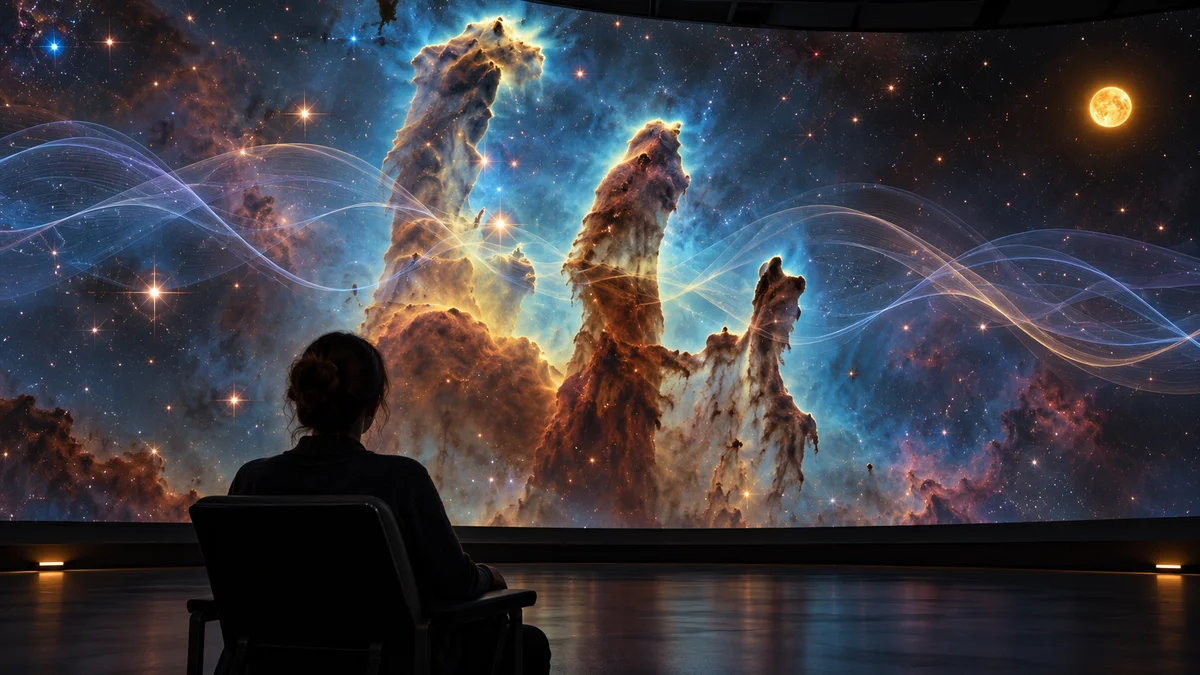
The Chandra X-ray Center’s explanation of the sonification gives you a listening key. The audio scans horizontally across optical and X-ray images. A feature higher in the picture is assigned a higher pitch. Compact sources make short, relatively pure tones; extended structures such as the pillars make broader, noisier sounds. As the scan crosses a pillar, its shape can be heard as a sweep through different pitches.
| In the image or scan | In the audio | What to remember | |---|---|---| | Movement from left to right | The order in which sounds arrive | This is the scan’s direction, not material travelling across the nebula | | A feature’s vertical position | Its assigned pitch | Higher pitch describes placement in the image | | A compact source | A short, pure tone | A note is an audio representation of image data | | An extended pillar | A broad, changing sound | The changing pitch helps trace its outline |
Chandra also offers the optical and X-ray parts separately and together. Try one at a time before the combined version. That makes it easier to notice that the audio has been designed to make different kinds of recorded light perceptible.
Are the pillars making this noise?
The track is synthesized from data in an image. Chandra describes combinations of sine waves controlled by those data; the individual sounds are choices in the translation. Hearing a low sweep does not mean a pillar emitted a low musical note, and a sharp tone is not a microphone recording of a star.
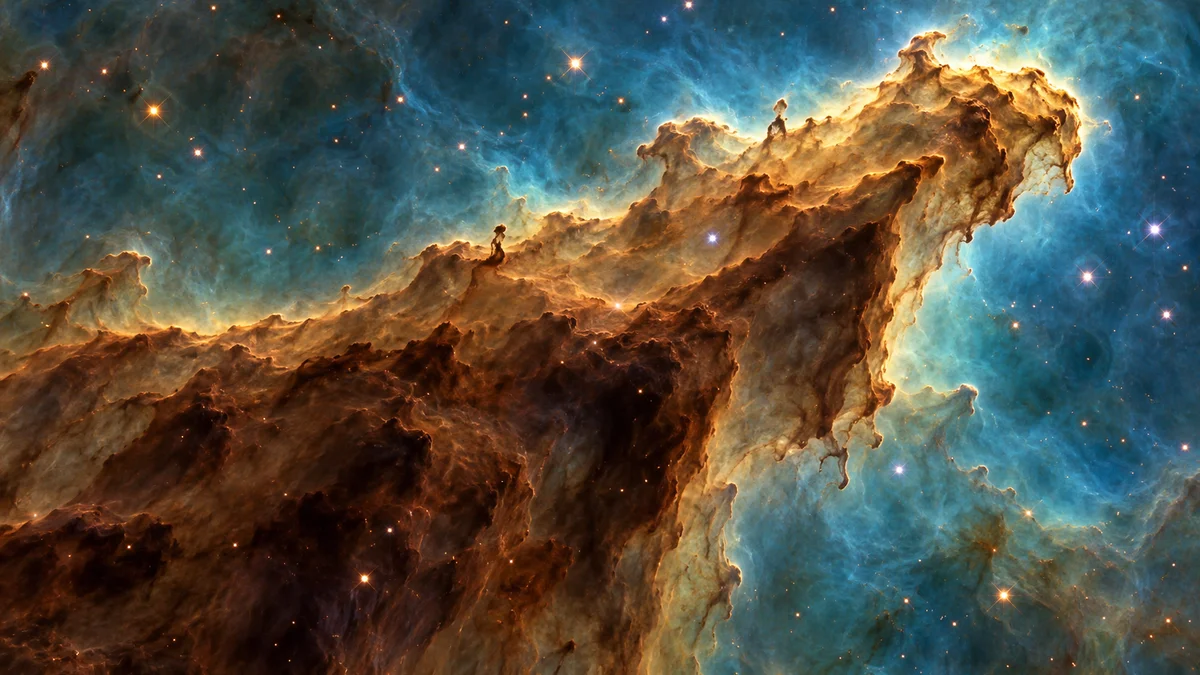
The underlying structures are real observations. NASA describes the Pillars of Creation as clouds of gas and dust within the Eagle Nebula. Radiation and winds from newly formed stars help shape them. The sound gives another way to follow features in the observations; the telescope images and their explanations remain essential for identifying what those features are.
The date matters, too. Although APOD highlighted this sonification in October 2026, Chandra’s account lists its release in September 2020. A new APOD selection is not a live feed from the pillars.
What does this have to do with our Sun?
The connection is star formation, not a shared location. According to NASA’s account of the Sun, it formed about 4.6 billion years ago from a cloud of gas and dust. Most of that material gathered into the Sun; other material helped form the planets and smaller bodies. The Eagle Nebula lets us examine a star-forming environment, but it is not an image or a soundtrack of the particular cloud that made our Solar System.
Open the Sun and planets in Solar System Live after listening. You are looking at the later chapter of a different system: a star with worlds around it. For two more views of stellar birth in our catalogue, compare the Cocoon Nebula and its dark dust with the young stars in the Carina Nebula. Those articles show why a dark cloud can be part of an active region, rather than an empty gap.
Then replay NASA’s Pillars video. Follow the moving scan with your eyes, listen for a compact tone and then for a long sweep. You will be hearing a way of reading an image—and seeing one stage of the broader story that eventually gave us the Sun.