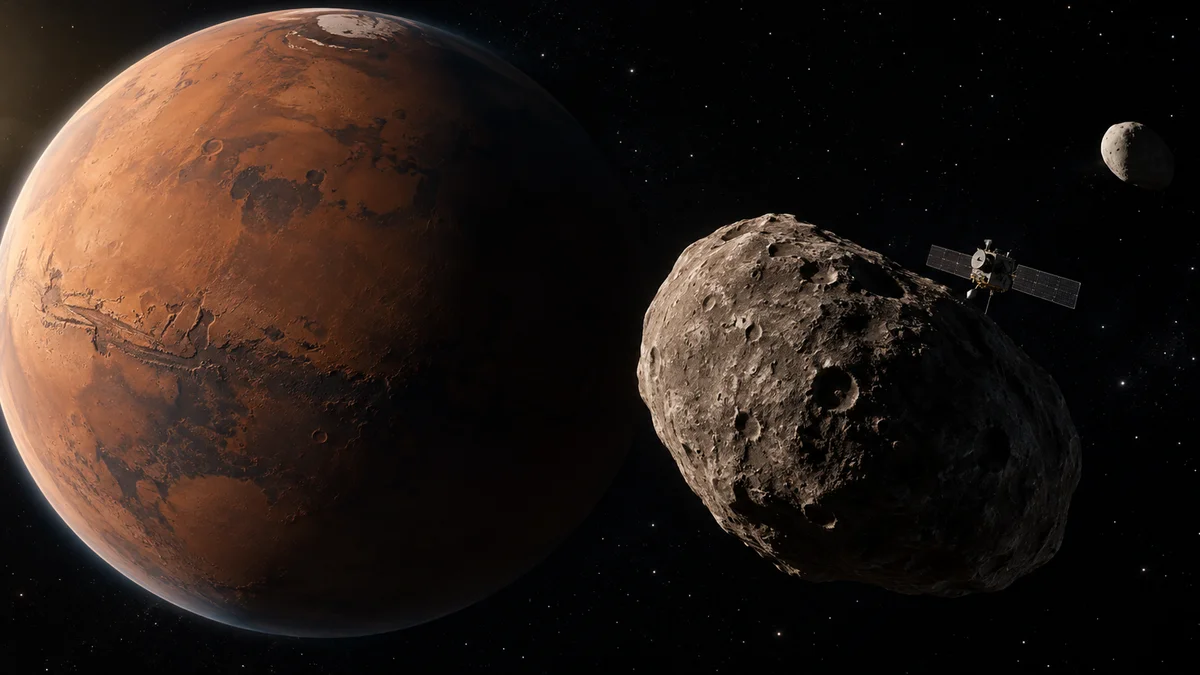
How did Mars get its moons? We do not yet know. Phobos and Deimos may be asteroids captured by Mars, or they may have formed from debris thrown into orbit by a collision with the planet. Japan’s Martian Moons eXploration mission, MMX, plans to examine both moons and bring material from Phobos to Earth to help distinguish between those explanations, according to JAXA’s science plan.
For a reader exploring Mars in Solar System Live, the useful question is what each kind of view can establish. A planetary view locates Mars in the Solar System. Images reveal the moons’ surfaces. Instruments can examine their composition. Returned grains can be studied in laboratories. None of those views, taken alone, is a recording of how the moons formed.
What do we know before MMX arrives?
Mars has two moons. Phobos is the larger and closer one; Deimos is smaller and farther away. NASA says Phobos circles Mars about three times a day, while Deimos takes about 30 hours per orbit. Both are irregular, dark bodies whose orbits are nearly circular and close to the plane of Mars’s equator. Those are observations of the moons as they are now, not direct observations of their beginnings. (NASA’s guide to the moons of Mars; NASA’s overview of moons.)
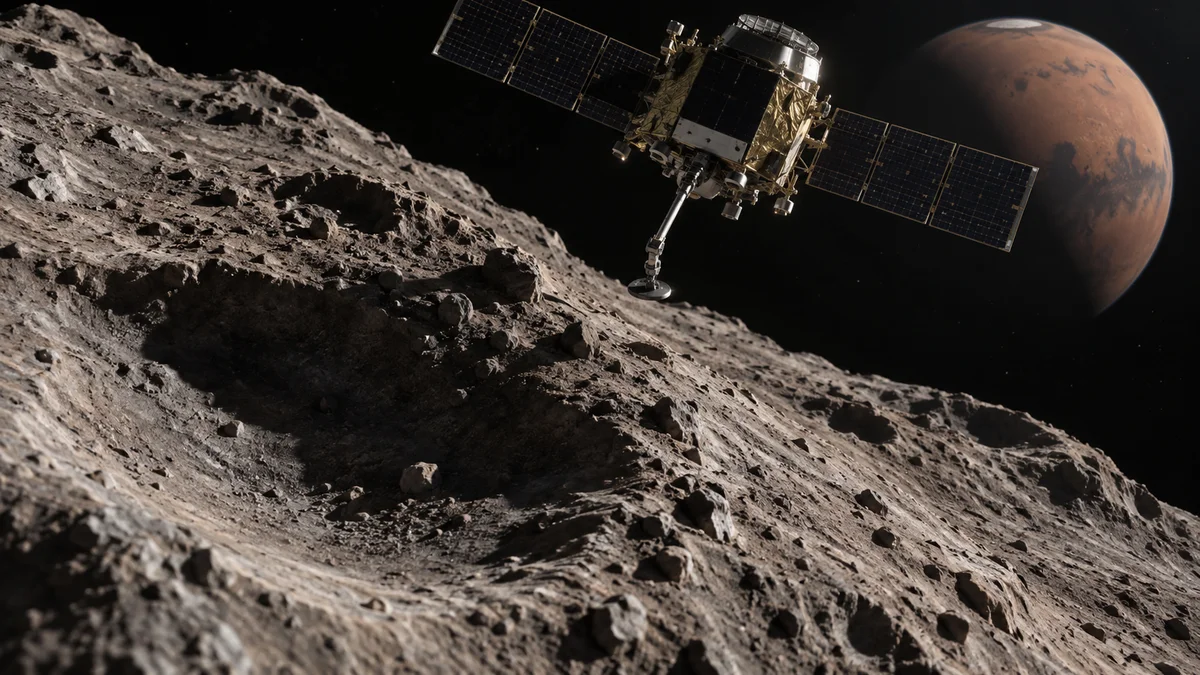
Their appearance has encouraged comparisons with asteroids. Yet resemblance is a clue, not an identification. JAXA sets out two competing explanations: either material from a major impact on Mars gathered into moons, or asteroids formed elsewhere were captured by the planet. The mission is designed to investigate their origin rather than assume that either account has won.
| Clue to examine | What it can tell us | What it cannot settle by itself | |---|---|---| | Present orbits | How Phobos and Deimos move around Mars today | The path by which they first became moons | | Surface images and measurements | How terrain and material vary across a moon | Whether every visible grain formed with that moon | | A returned Phobos sample | What the collected material contains when analysed on Earth | Deimos’s composition without observations of Deimos |
This comparison draws on NASA’s description of the moons and JAXA’s planned observations and sampling. Its last limit matters: MMX plans to sample Phobos, while observing Deimos from a distance.
Why might a Martian grain on Phobos be misleading?
JAXA expects Phobos to have collected material ejected from Mars by impacts. Finding material of Martian origin in a Phobos sample would therefore be valuable, but one such grain would not, by itself, prove that the whole moon formed in a giant impact. Scientists would need to interpret a grain’s origin alongside the rest of the sample and the observations of the surface from which it came. (JAXA’s explanation of material transferred from Mars.)
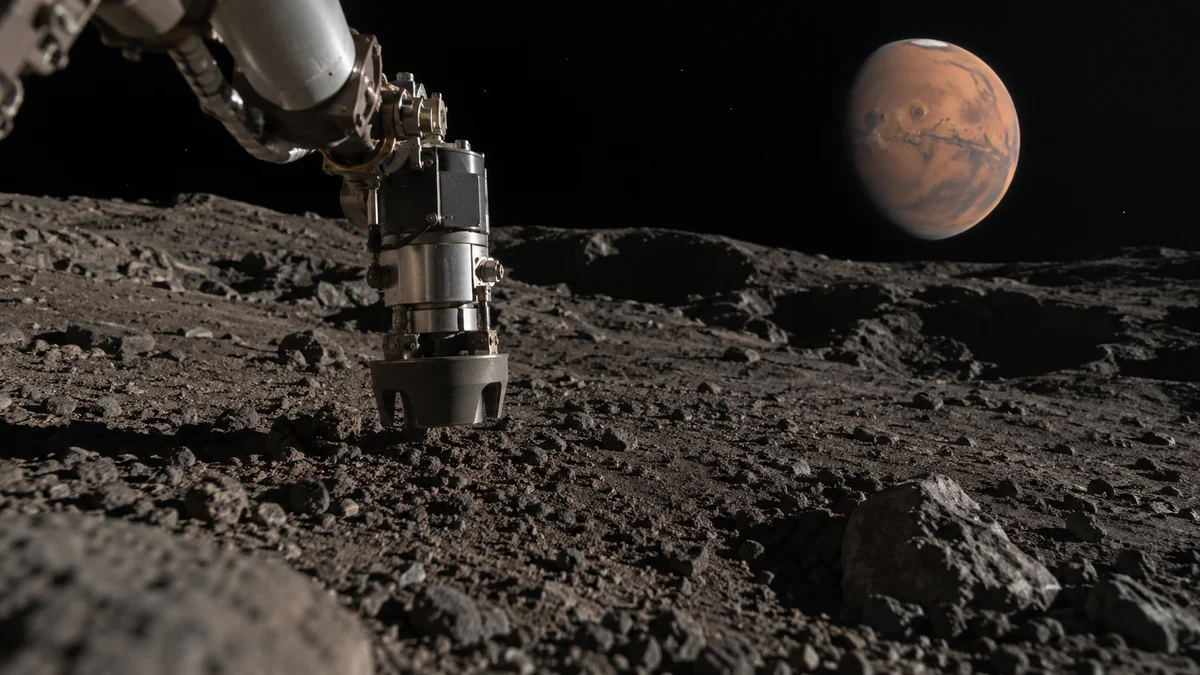
This is why MMX combines methods. JAXA plans detailed images and measurements to select a landing site, observations of Deimos, and the return of more than 10 grams from Phobos. NASA says its MEGANE instrument will measure the chemical elements at Phobos’s surface using gamma rays and neutrons. Those measurements can give the returned material context; the planned sample can, in turn, let researchers examine physical grains rather than rely only on reflected light. (JAXA mission plan; NASA’s MMX briefing.)
When will there be an answer?
As of October 16, MMX has not launched. JAXA lists liftoff for October 20, 2026, in Japan and targets the sample’s return to Earth in 2031. Those are scheduled milestones, not completed results. The mission may narrow the possibilities before the samples arrive, but its planned observations should not be mistaken for findings already made. (JAXA’s mission page.)
To put the investigation in context, open Mars in Solar System Live and locate the planet among the other worlds. The simulator does not display a laboratory analysis or reveal a moon’s birthplace. For a closer look at Phobos’s visible terrain, read our guide to Stickney Crater. Our article on Martian gullies follows a different question about the planet’s surface.
Then return to JAXA’s mission sequence. Watch for three distinct steps in later reports: observations of both moons, collection on Phobos, and analysis of the returned material. That sequence is how a question about two tiny companions can become a test of their origin.