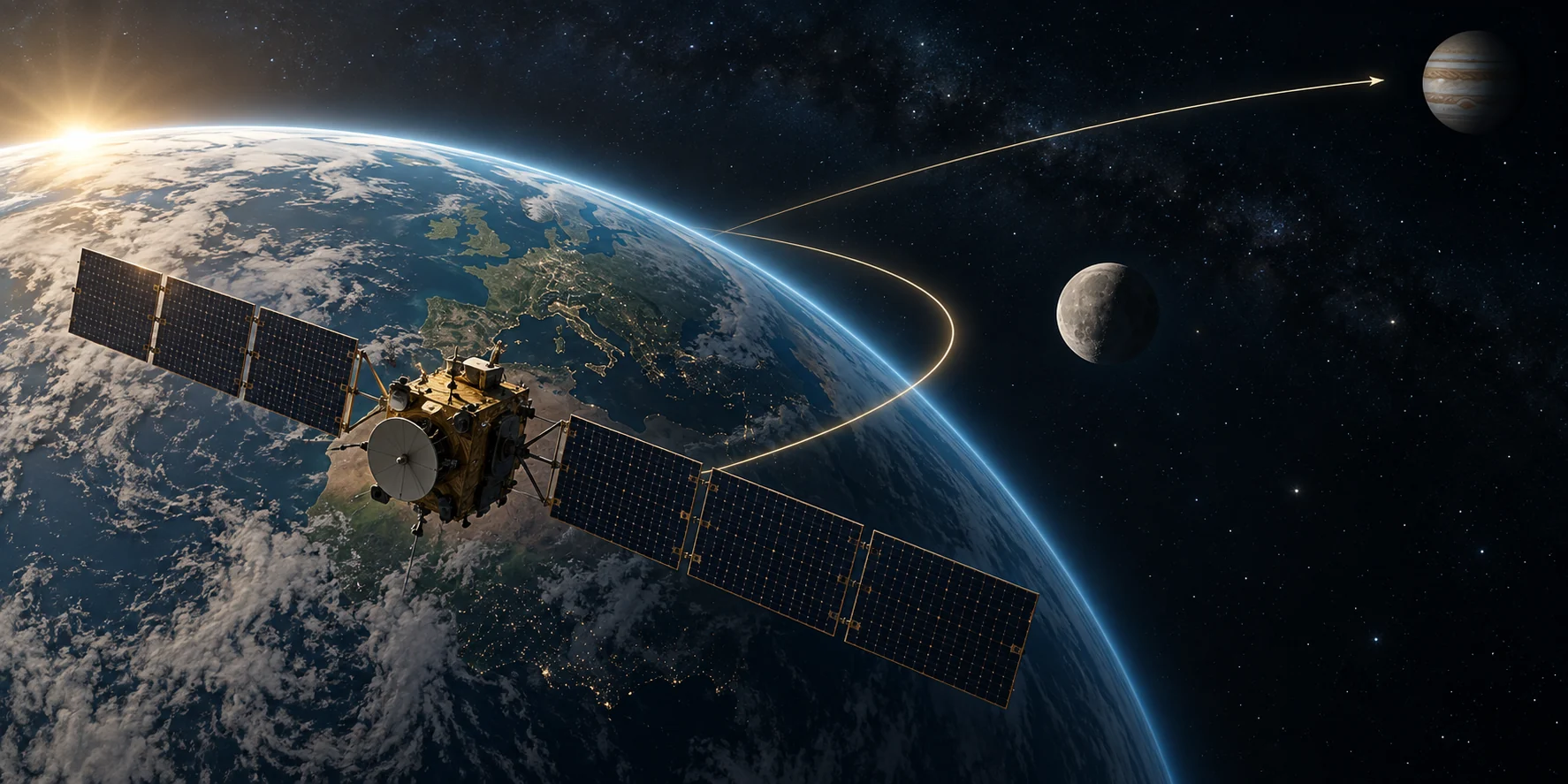
ESA planned for its Jupiter Icy Moons Explorer, Juice, to pass Earth on 28 September 2026. The aim is not to visit Earth again for its own sake: Earth's gravity bends the probe's trajectory and changes its speed, helping it reach Jupiter without carrying the fuel a more direct route would demand. This article explains the published plan, not a confirmed post-flyby result.
What is expected to happen near Earth?
ESA's pre-flyby briefing puts closest approach at 13:45 Central European Summer Time, above the Indian Ocean, at a distance of about 8,640 km. The mission team expected the encounter to turn Juice's path by roughly 20 degrees and increase its velocity by about 3.5 km/s. Those are planned values, not numbers we have measured ourselves or a claim that the operation has already succeeded.
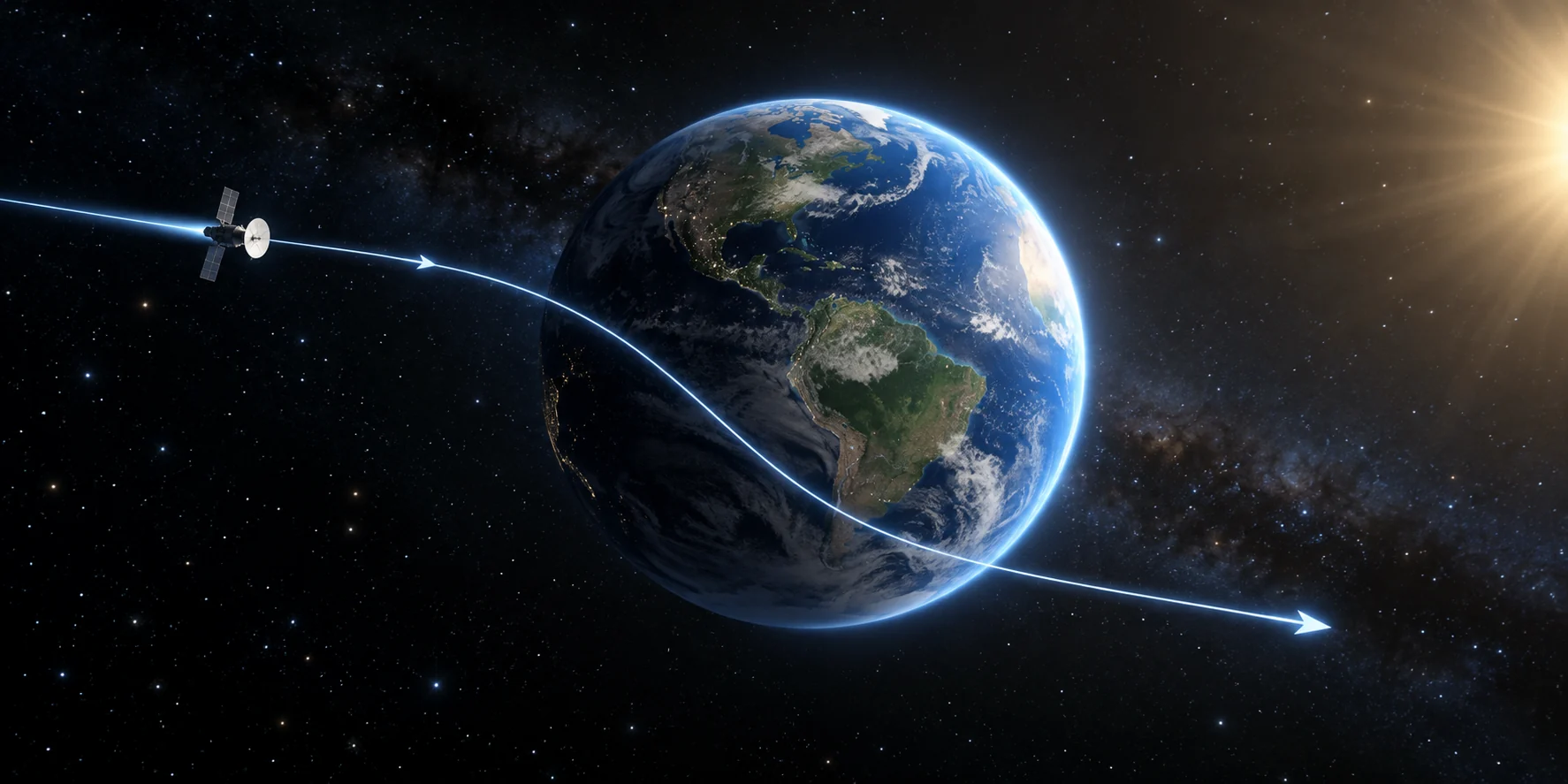
The geometry is the interesting part. A gravity assist does not simply pull a spacecraft toward a planet and then release it along the same line. The probe approaches on one side and departs along a different path. Relative to the Sun, the moving planet can transfer orbital energy to the probe. That change in direction and speed is precisely what the mission planners need for the next leg. A simple view of the Sun, Earth and Jupiter in a Solar System simulator helps show why a straight line drawn between two planets cannot stand in for a real flight trajectory; it is not a live reconstruction of Juice's exact position.
Why use a long route instead of flying straight to Jupiter?
Juice launched in April 2023. ESA describes an earlier lunar-Earth flyby and a Venus flyby before this return to Earth. The 2026 encounter is intended to set up a final Earth flyby in January 2029 and an arrival at Jupiter in July 2031. The target after Jupiter is even more specific: the mission plans to enter orbit around Ganymede in 2034.
Flying directly to Jupiter and then braking into orbit would require much more propellant, according to ESA. A sequence of planetary encounters changes the spacecraft's solar orbit while preserving fuel for the eventual Jupiter-system science. “Free” gravity assistance does not mean the mission is effortless: the aim point and timing must be carefully controlled, and the remaining orbital manoeuvres still matter.
The flyby doubles as an instrument rehearsal
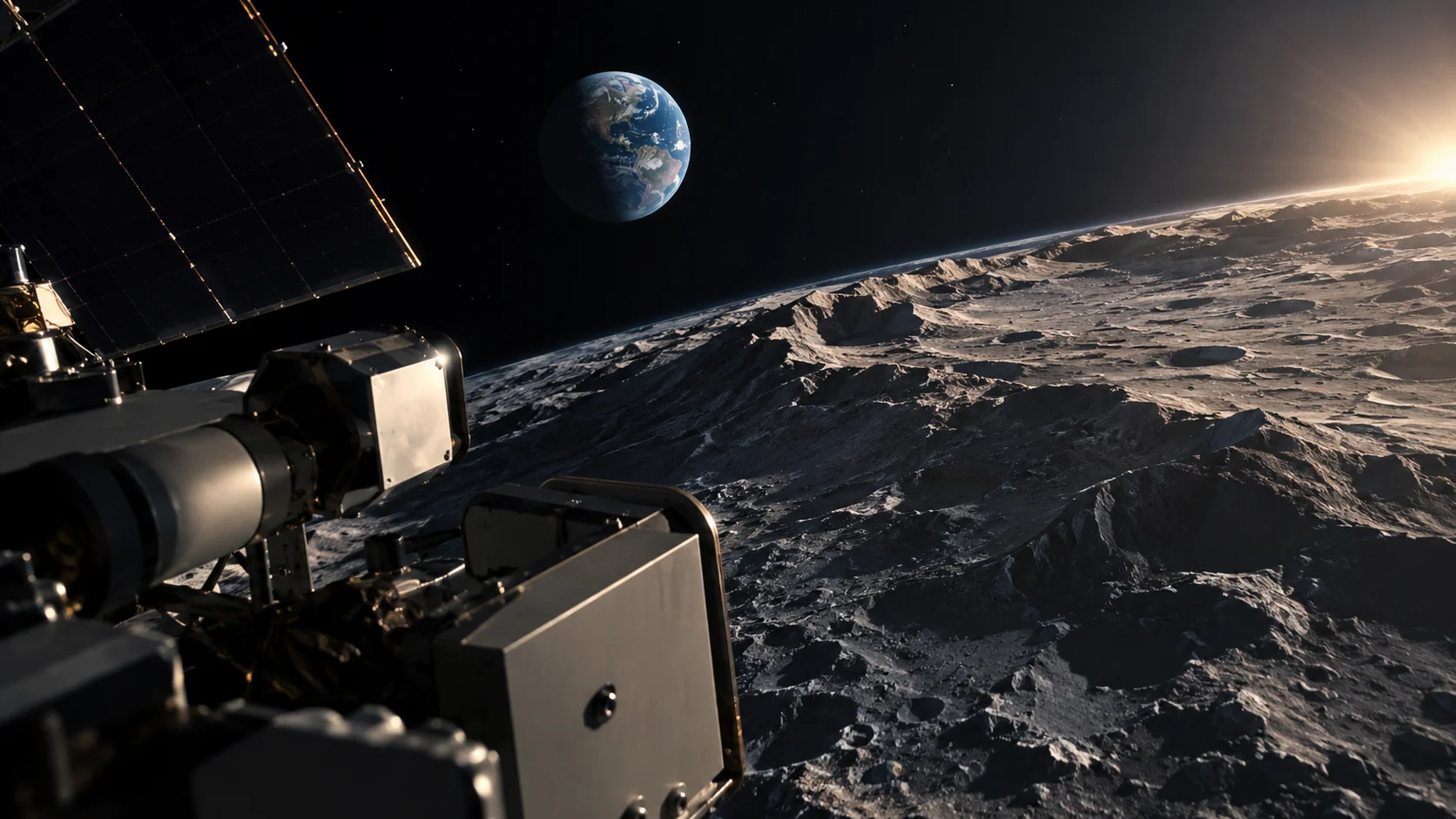
ESA says Juice's ten science instruments are scheduled to collect Earth and Moon data between 23 September and 3 October. The opportunity lets instrument teams calibrate and test analysis methods against familiar nearby targets before the measurements at Jupiter and its icy moons. The navigation camera is also due to view the lunar horizon to test an optical-navigation technique.
Mission operators planned for a period in Earth's shadow shortly before the close approach, when the spacecraft would rely on battery power. This is one reason the team prioritized observations. ESA also expected measurements while Juice travels through Earth's magnetotail. All these details are plans described before the encounter; data quality and final mission performance require later confirmation.
What to check after the encounter
For a genuine outcome, look for ESA's post-flyby update rather than assuming the scheduled trajectory was achieved. An official update should distinguish the predicted closest approach from the measured trajectory and say whether the spacecraft and instruments remained healthy. In the meantime, this passage offers a concrete example of orbital mechanics: a planet is not merely a destination, but a moving part of the route to another world.
The accompanying images are AI-generated conceptual illustrations, not ESA photographs or scale-accurate mission diagrams.