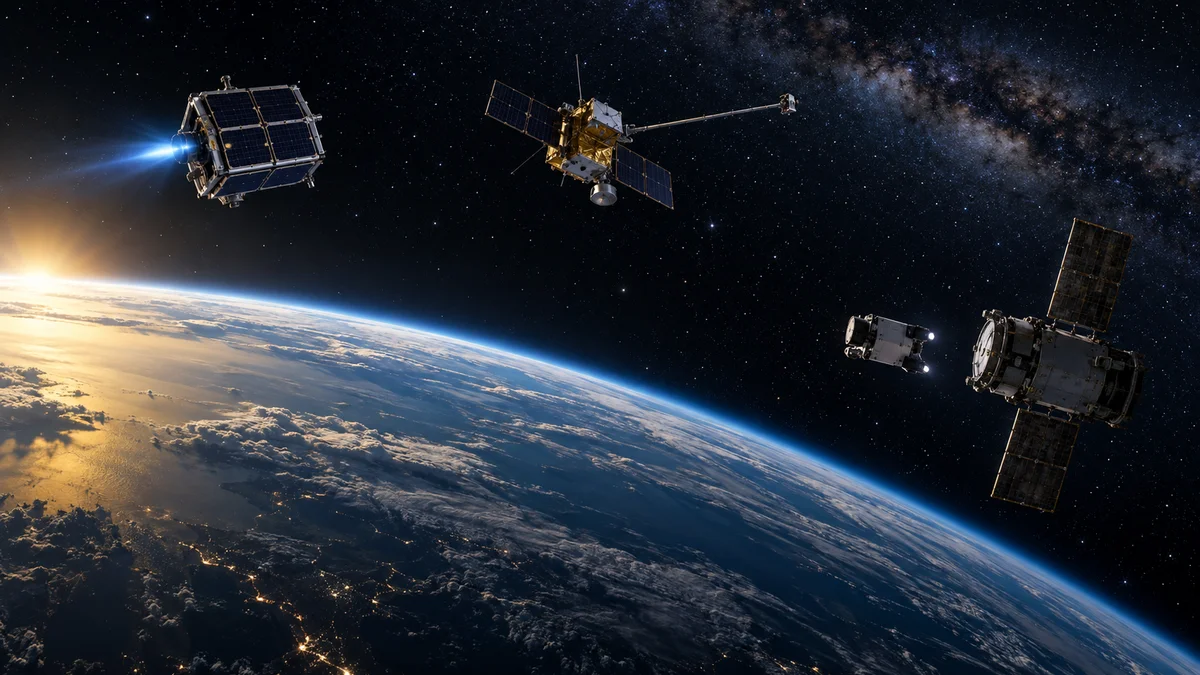
What did NASA’s Transporter-18 satellites launch to do? The three NASA-supported spacecraft have different assignments: test propulsion, investigate material and radiation moving through galaxies, and develop ways to inspect inactive satellites. They appear together in a NASA photograph taken before launch, but sharing a rocket does not make them one experiment.
The photograph shows the spacecraft with commercial payloads before they were enclosed for the October 1, 2026, launch. To understand the picture, it helps to ask two questions of each mission: Where is the spacecraft? and What is it trying to learn or demonstrate? Those answers need not point to the same place.
What are the three spacecraft for?
NASA identifies the missions as the ASCENT Propulsion Dual Mode CubeSat, the SPRITE CubeSat, and Small Spacecraft Propulsion and Inspection Capability, or SSPICY. Its description of the prelaunch image gives each a distinct purpose.
| NASA-supported mission | Its stated task | The question to keep in mind | |---|---|---| | ASCENT Propulsion Dual Mode CubeSat | Demonstrate new propulsion technology | How can a small spacecraft change the way it moves? | | SPRITE CubeSat | Study how galactic dust and high-energy radiation move through galaxies | What can a spacecraft learn about places far beyond the Solar System? | | SSPICY | Advance the ability to inspect inactive satellites | How can one spacecraft examine another? |
This is a guide to mission goals, not a report that the demonstrations have succeeded or that SPRITE has already returned findings. The image records a moment in launch preparation. It cannot show the later results of any of the three missions.
Why does SPRITE belong beside two technology missions?
SPRITE is the easiest mission to misplace on a mental map. NASA says it will study dust and high-energy radiation moving through galaxies. That describes its subject of investigation, not a trip by the CubeSat to another galaxy.
ASCENT and SSPICY make a different kind of question visible. Their stated aims concern what small spacecraft can do: propel themselves or inspect an inactive satellite. SPRITE’s stated aim concerns what a spacecraft can find out about distant material and radiation. All three are small spacecraft in the same prelaunch photograph, yet their objectives reach across very different scales.
The distinction is useful whenever a mission description names a remote object. An instrument can collect information about something it never approaches. Likewise, a propulsion test can matter without the spacecraft visiting a planet. The destination of a rocket, the location of its payload, and the subject of its research are separate pieces of a mission.
What can Solar System Live add to the picture?
Solar System Live offers a view of the Sun, Earth, and other navigable bodies in our planetary neighbourhood. Start with Earth in the 3D simulator. It supplies the local setting that the close-up photograph leaves out. The simulator does not identify these three spacecraft, trace their paths, display an inactive satellite, or show the galactic dust SPRITE studies.
Our articles on how fast the ISS orbits Earth and orbital rendezvous with Progress 96 explore questions about spacecraft moving near our planet. For a subject beyond the Solar System, the article on the Pa 30 supernova remnant provides a different scale of astronomical reading. Those articles offer context; they do not describe the Transporter-18 spacecraft or their results.
How should you read the NASA image?
Look at it first as a record of shared launch preparation. Then use the table to give each NASA-supported spacecraft its own question. Finally, open Earth in the simulator and notice the limit of that view: it can place our planet within the Solar System, while the NASA photograph names hardware and research aims that a planetary view cannot reveal. Read the NASA image article again with those scales separated.