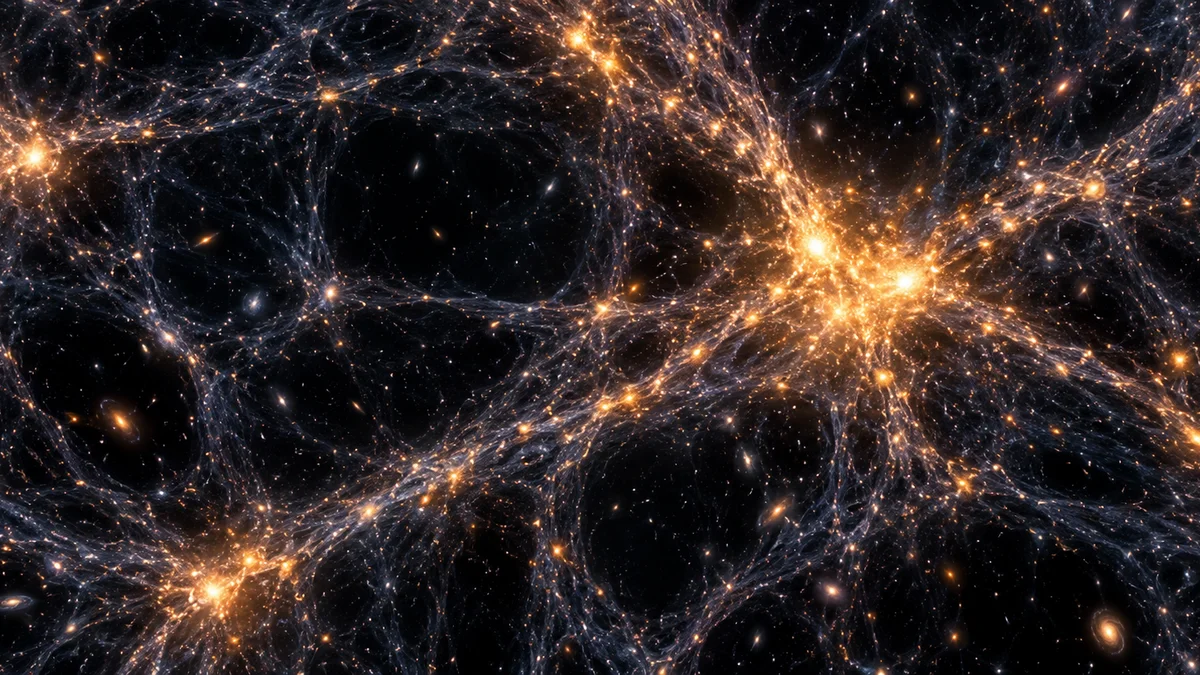
The black filaments in NASA’s image represent dark matter in a computer simulation; the orange clumps represent familiar matter. They are visual choices, not colors recorded by a telescope. The image appeared as NASA’s Astronomy Picture of the Day on 25 October 2026. It illustrates a model of structure across the universe, not a new photograph of something near Earth. NASA identifies both the simulation and its color key.
That distinction is especially useful on Solar System Live. Our 3D view helps you explore the Sun and planets in their current arrangement. NASA’s image asks a different question: how might unseen matter be distributed on a vastly broader scale? Putting the two views side by side gives the word simulation a more precise meaning.
Is the black web a photograph of dark matter?
No. According to NASA’s description of the image, the web comes from a computer simulation. Its dark strands depict modeled dark matter, while orange marks clumps of ordinary matter. Black does not describe the material’s natural appearance.
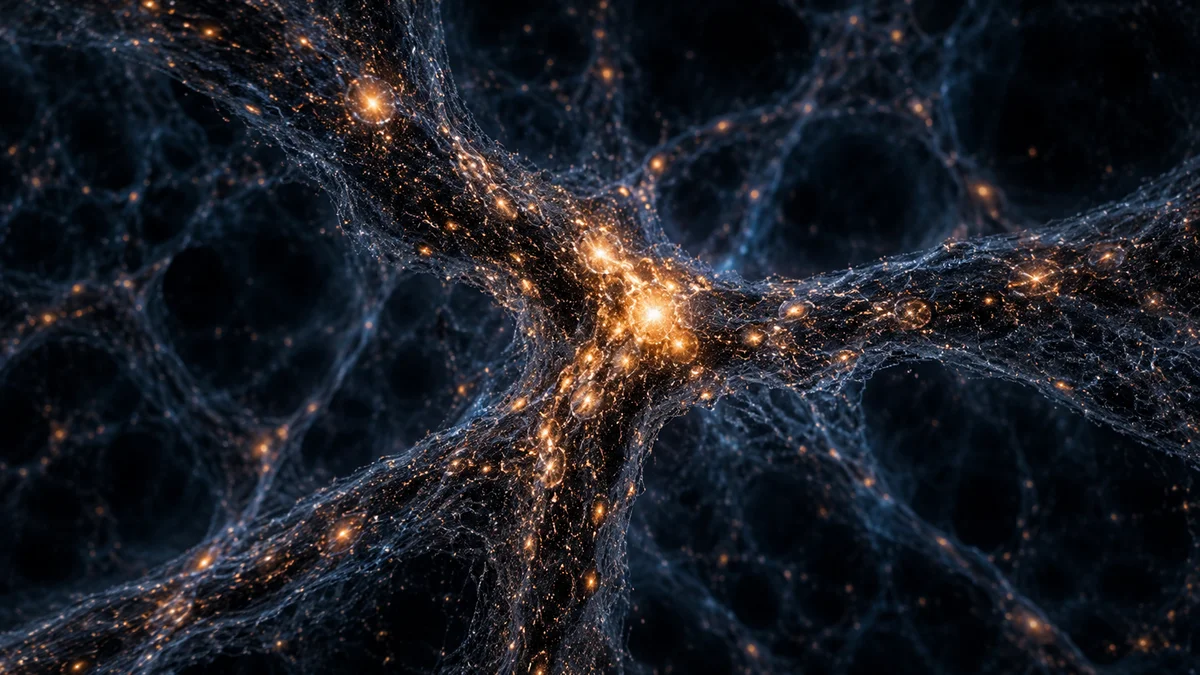
Dark matter is called “dark” because it does not appear to absorb, reflect or emit light. Astronomers investigate it through its gravitational effects, including the motion of galaxies and the way gravity bends light from more distant objects. NASA’s dark matter guide explains those lines of evidence and distinguishes maps inferred from observations from pictures of visible material.
So what should you take from this particular image? Look at the pattern: strands and concentrations in a model built to examine cosmic structure. Do not treat a strand’s drawn width or its black color as something an observer could see by flying through space. NASA says such simulations agree well with astronomical observations statistically; that does not make every illustrated filament an individually photographed object.
What can Solar System Live add to this picture?
Start with the scale you can navigate. In Solar System Live, find the Sun, then Earth, Jupiter and Neptune. You are looking at named bodies and their arrangement within one planetary system. Return to the NASA image and try to find any of those bodies. You cannot: the image is concerned with the distribution of matter across the universe, not a map of planetary positions.
| View | What you can use it to ask | What it does not show | |---|---|---| | Solar System Live | Where are the Sun and planets in the simulated Solar System view? | The dark matter web in NASA’s image | | NASA’s illustrated simulation | How might dark and ordinary matter form a large-scale pattern? | A live view of individual planets | | NASA’s dark matter guide | What observations lead astronomers to infer unseen mass? | A direct photograph of dark matter |
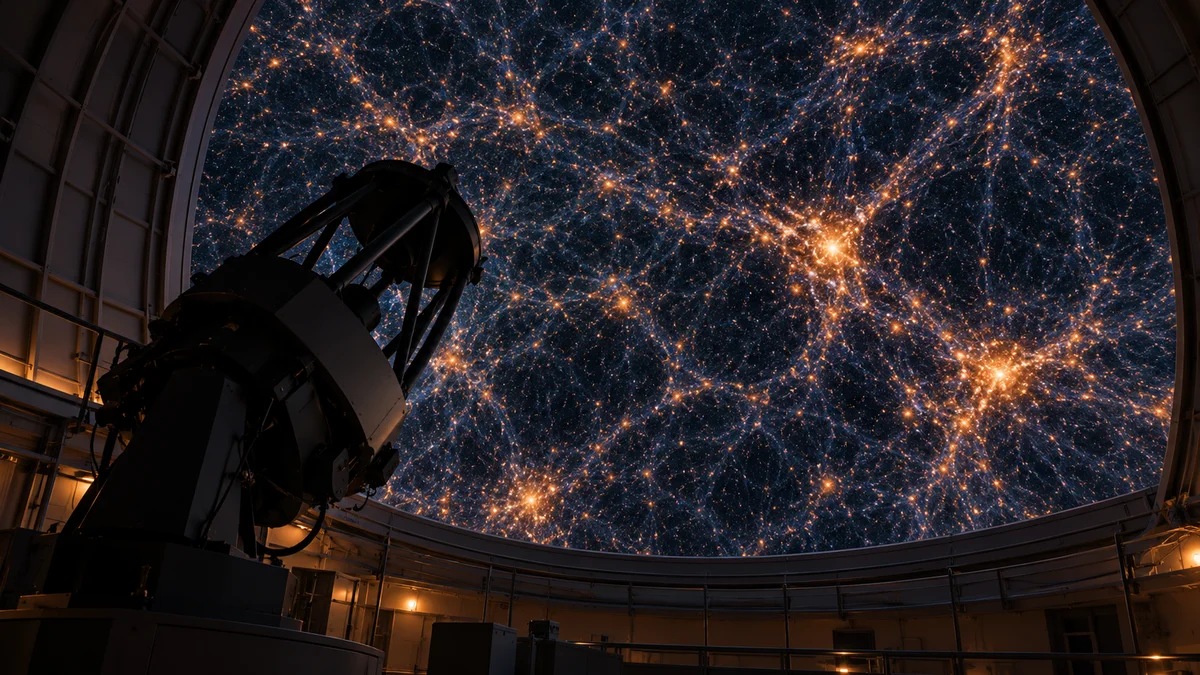
This comparison is the contribution of a Solar System site: it tells you which question to bring to each view. A 3D display can make either scene feel immediate, but visual clarity does not give the scenes the same scale, purpose or evidential status.
Does “simulated” mean scientists invented dark matter?
No. A simulation tests what follows from a model; observations test how well that model describes the universe. NASA lists galaxy motions and gravitational lensing among the reasons astronomers infer dark matter. The simulation in the APOD helps visualize a possible distribution consistent with observations. It does not, by itself, identify what dark matter is made of.
Our article on Cloud-9 follows a separate question about dark matter and an unusually faint object. For a view closer to the planets, read about zodiacal light: there the subject is light associated with dust in the Solar System, not the dark web in this cosmic simulation.
Open Solar System Live and locate the Sun and outer planets. Then revisit NASA’s image with one question in mind: what does each view represent, and what would count as evidence for it?