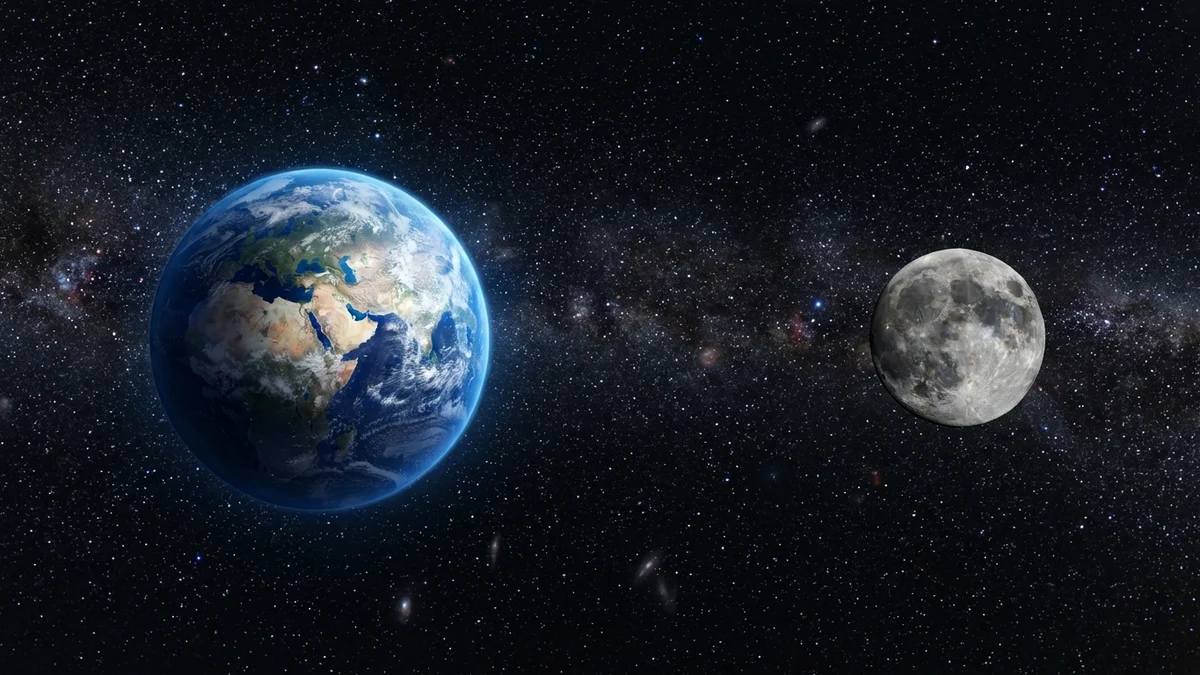
Short answer up top: physicists still don't agree on an exact line between the quantum world and the classical one we live in, but they do agree on the mechanism that erases quantum weirdness at large scales — a process called decoherence. A recent Quanta Magazine podcast on this question, published September 17, 2026, is a good excuse to point at something you can check yourself: on Solar System Live's real-time 3D simulator, the Moon and every planet always sit in one exact, definite spot. That "always-there-ness" is the classical side of the boundary the podcast is arguing about.
What is decoherence, really?
In the podcast, Imperial College London physicist Jonathan Halliwell describes how a quantum system loses its wave-like weirdness: constant bombardment by its surroundings — light, air molecules, anything nearby — kills the interference that makes quantum behavior visible in the first place. A single particle can interfere with itself in a lab, isolated from its environment. The moment it interacts with enough of the outside world, that self-interference disappears, and the system starts behaving like an object with one definite state — the way a tennis ball, a planet, or a moon behaves.
Einstein's question about the Moon
The episode revisits a famous objection Einstein raised against strict interpretations of quantum mechanics: does the Moon exist when nobody is looking at it? Under the Copenhagen interpretation associated with Niels Bohr, unmeasured quantum systems don't have definite properties until observed. Einstein found it absurd to extend that idea to something as large as the Moon. Decoherence is the answer physicists now give: the Moon doesn't need a conscious observer to "collapse" into existence, because it's already being constantly bombarded by sunlight, solar wind, and the rest of its environment — countless tiny interactions that pin it into one classical, definite state every instant, whether or not any human is watching.
How far has this actually been tested?
The boundary isn't fixed at any particular size just because physicists say so — it's pushed experimentally, one careful test at a time. According to the podcast, quantum electrodynamics has been confirmed to a precision of one part in 10 to the 12th power, and interference experiments — a specialty of Oxford physicist Vlatko Vedral — have been run with particle paths separated by just millimeters. Tests of quantum "realness," the Leggett-Garg experiments mentioned in the discussion, have been pushed up to systems of thousands of atoms without losing quantum behavior. That's already an enormous jump from a single electron, but it's still unimaginably far from a moon, a planet, or a spacecraft — which is exactly why nobody expects, or has ever seen, a planet do anything but sit in one place.
Where the simulator fits in
Solar System Live doesn't touch quantum mechanics — it plots the real, classical positions of the Sun, the planets and their moons, updated continuously from real orbital data. But that's precisely what makes it a useful companion to a story like this one: every object you see moving across the simulator is a working example of the classical side of Halliwell's boundary, pinned into a single, definite, trackable position by nothing more mysterious than being large and constantly connected to its environment. Open the simulator, watch the Moon orbit Earth in real time, and you're looking at the everyday answer to Einstein's question — no observer required.
The debate that isn't settled
None of this means physicists have found the precise size, mass or number of atoms at which "quantum" flips into "classical." The podcast notes competing frameworks — from Murray Gell-Mann's consistent-histories approach to the Hartle-Hawking "no-boundary" proposal for the universe itself — that try to describe the transition without needing an external observer at all. What decoherence gives us is a mechanism, not a sharp line. The next step, if you want to see the practical result of that mechanism rather than just read about it, is simple: go look at where the Moon actually is right now.