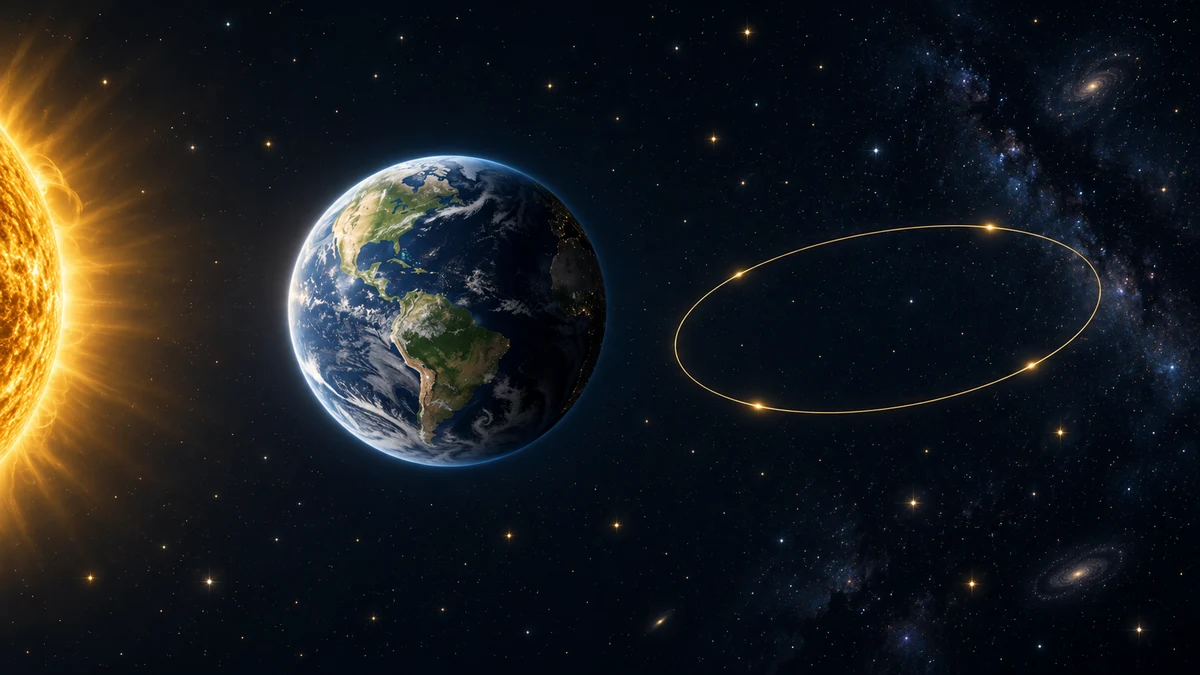
The James Webb Space Telescope travels around the Sun, rather than circling Earth like Hubble. Its observing region lies near the Sun–Earth L2 point, roughly 1.5 million kilometres beyond Earth in the direction away from the Sun. That position is part of the telescope's design, not simply a remote parking space.
A point with no object inside it
As ESA explains, Lagrange points arise from the relationship between gravity and orbital motion. L2 is a location in that arrangement: there is no hidden planet at its centre. Imagine marking a useful place on a moving map rather than finding a new destination with a solid surface.
Keeping those two ideas separate helps when reading illustrations. A dot marked L2 identifies a position. A loop around that dot depicts a path. Neither represents a physical ring in space, and a compact drawing cannot preserve all the real sizes and distances.
Two views of the same journey
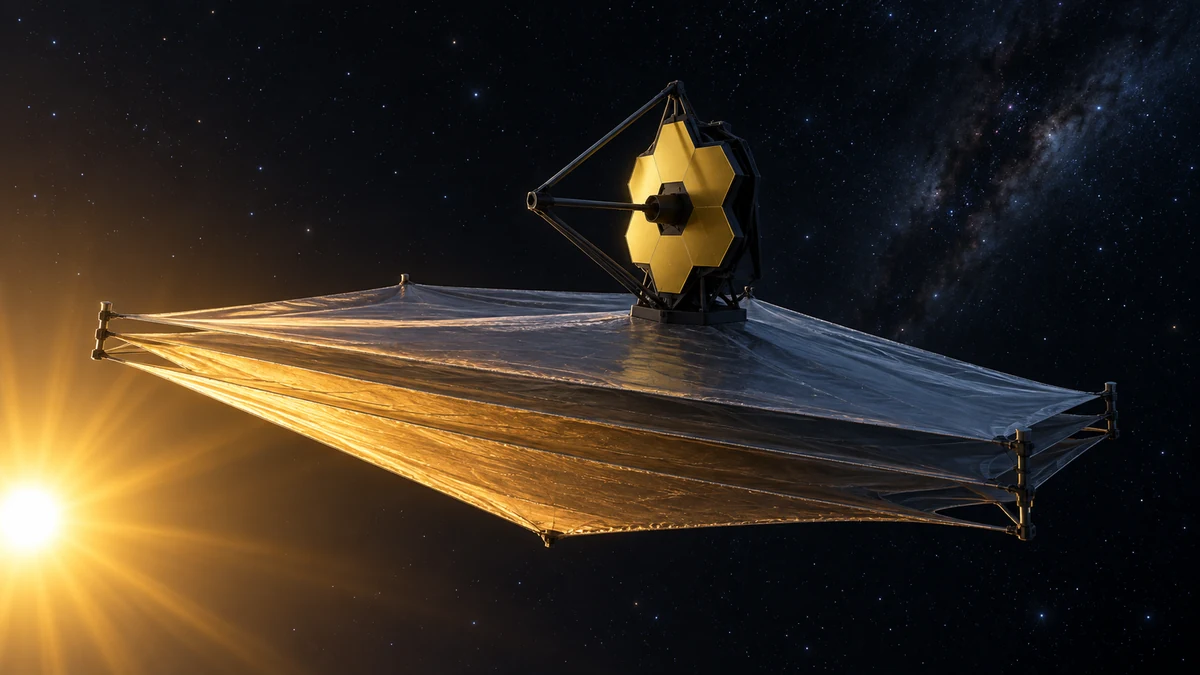
NASA's orbit guide describes Webb as orbiting the Sun while following a halo orbit around L2. These descriptions use different viewpoints and do not contradict each other. Relative to the Sun, follow the broad annual journey; relative to the Earth–Sun arrangement, follow the loop around the L2 region.
Webb does not remain motionless exactly on the point. Think of the diagram's reference frame before deciding what a line means. A diagram that keeps Earth fixed is a useful explanatory view, not a claim that Earth has stopped moving.
Why cold instruments benefit
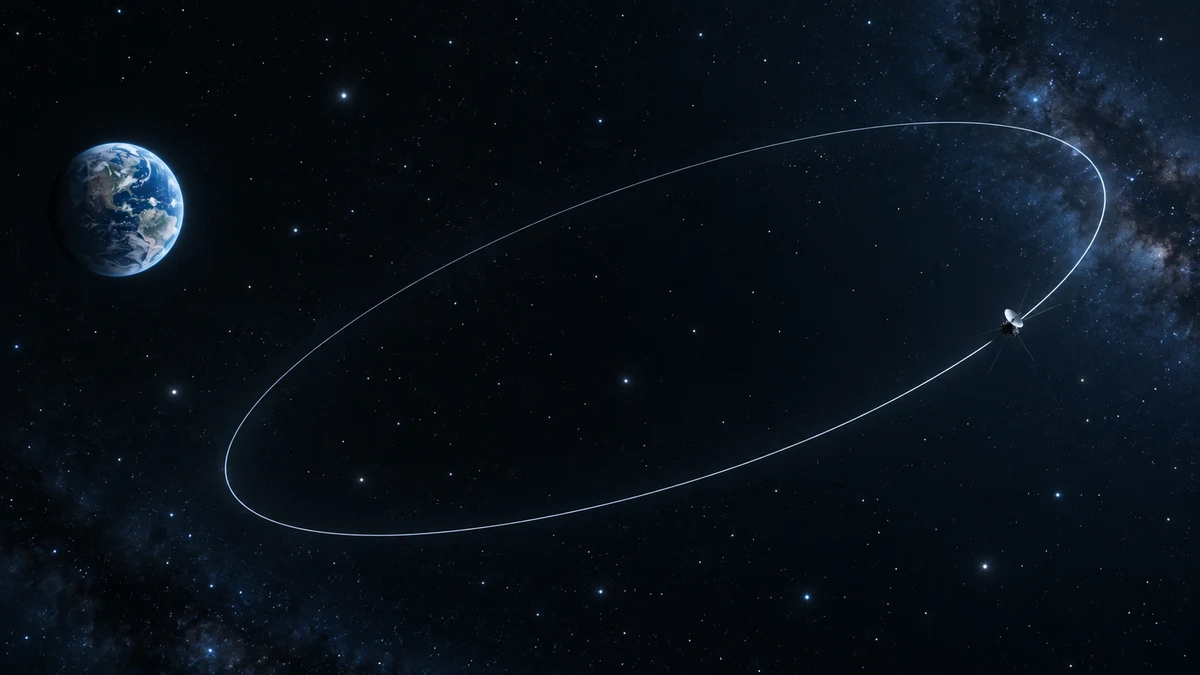
The geometry helps keep the Sun, Earth and Moon on the shielded side of the observatory. This matters for a telescope studying faint infrared light. ESA also describes the region as offering a steadier thermal environment than repeatedly passing into and out of Earth's shadow.
Distance alone is not the solution: the orbit and sunshield work together. When an illustration places warm illumination on one side and the optics on the other, it is explaining that separation, not reproducing a photograph taken beside Webb.
Arrival was a manoeuvre, not a landing
On 24 January 2022, ESA reported the correction burn that sent Webb towards its intended halo orbit. Its report also explains why propellant remains important for small orbital adjustments during operations. Reaching L2 did not make the spacecraft permanently self-positioning.
Use three checks when looking at the next orbital graphic: locate the Sun, locate Earth, then identify the region beyond Earth. Only then trace the loop. The conceptual AI illustrations here are not to scale and do not reproduce the observatory's exact engineering design.