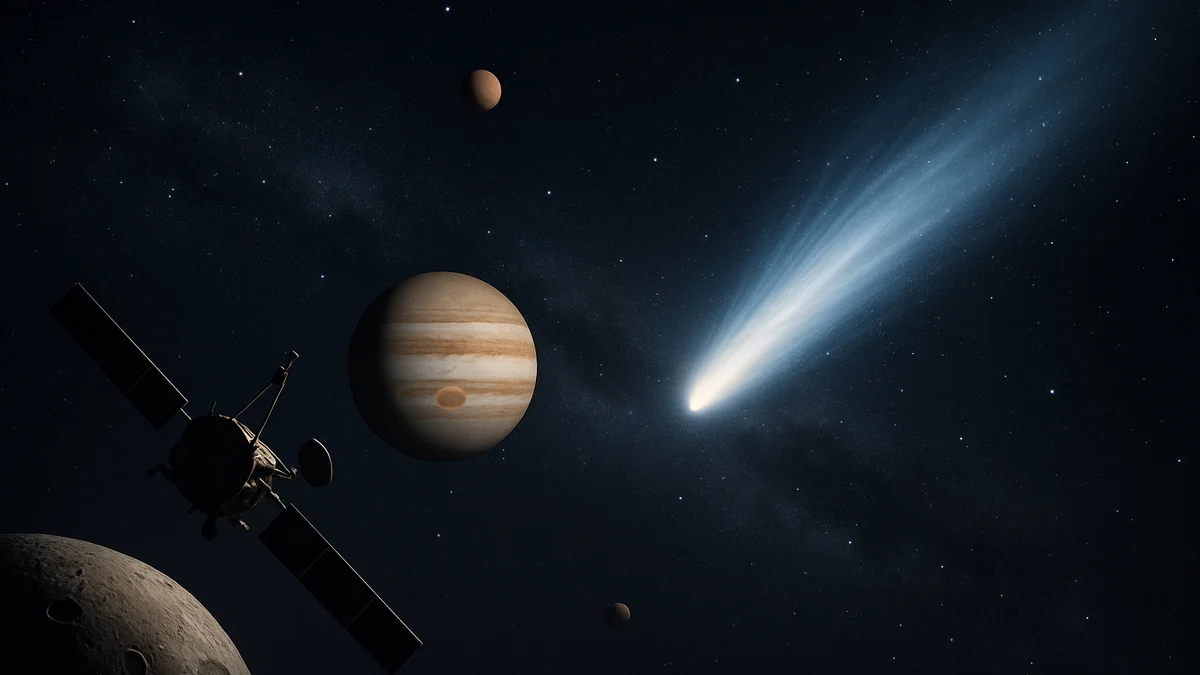
Halley's Comet last passed close to the Sun in 1986. It won't return until 2061. A newly published mission concept, described in a preprint led by researchers at Khalifa University, proposes launching a spacecraft that would need every one of those intervening decades — not to wait, but to fly.
Why does reaching Halley take over 20 years?
Because Halley's Comet doesn't orbit the Sun the way the planets do. Its orbit is tilted about 162 degrees relative to the plane the planets travel in, which in practical terms means it moves backward — retrograde — compared to Earth, Jupiter, Mars, and everything else circling the Sun in the same direction. Matching a spacecraft's velocity to an object moving the "wrong way," on a steeply tilted path, costs enormously more propellant than catching up to something orbiting alongside you.
The proposed solution is patience combined with borrowed momentum. The mission concept describes launching in one of two optimal windows — August 2036 or September 2037 — and then using double gravity assists at Jupiter and Saturn to bend the trajectory and build up speed without carrying that fuel onboard. Even with that help, the paper estimates a journey of more than 20 years, arriving at Halley around 2060, roughly a year before the comet reaches perihelion (its closest point to the Sun) in 2061.
What would the spacecraft actually do there?
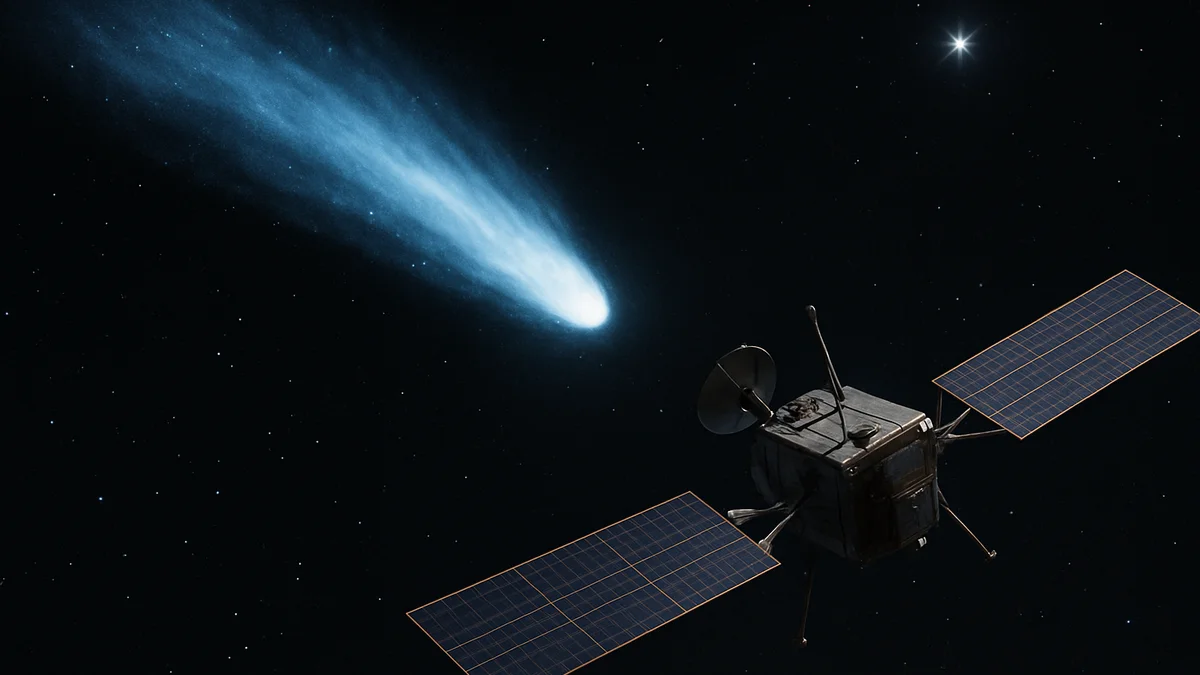
Unlike the brief flybys of the past, this concept is designed to stay. The proposed spacecraft would carry a 750 kg science payload out of a total mass of about 2,000 kg, powered by a radioisotope thermal generator — the same flight-proven technology used on deep-space missions that travel too far from the Sun for solar panels to work — and propelled by Hall-effect thrusters, an efficient ion-propulsion system already used on other spacecraft. Rather than the few hours of close observation that past missions managed, this design is meant to accompany the comet for months, watching it wake up as sunlight starts vaporizing its ice on the approach to perihelion.
That distinction matters. The last time humanity had eyes on Halley up close was 1986, during what's remembered as the "Halley Armada": ESA's Giotto probe and the Soviet Vega 1 and Vega 2 spacecraft all flew past the nucleus at high speed, gathering what data they could in a matter of hours before continuing on. A rendezvous mission — one that matches the comet's speed and travels alongside it — would be a fundamentally different kind of visit, closer to escorting the comet than photographing it in passing.
Is this mission actually happening?
Not yet. What's been published is a mission architecture in a scientific preprint — an engineering case for how such a trip could be done with existing, flight-proven technology, not an approved or funded space agency program. Missions like this typically take years of review, competition, and budget approval before a launch date becomes real. What the paper does establish is that the physics and the hardware are not the obstacle: the 2036/2037 windows and the Jupiter-Saturn gravity-assist route are calculated as achievable with propulsion systems that already exist.
Why Halley's tilted orbit is worth seeing, not just reading about
Most comets and planets in our solar system share a rough family resemblance: they circle the Sun in more or less the same plane, in the same direction. Halley breaks both rules at once, and that combination — retrograde motion at a steep 162-degree inclination — is exactly the kind of orbital geometry that's far easier to understand by watching it than by picturing it from a description. On the real-time 3D simulator at Solar System Live, you can see how differently an object like Halley moves compared to the planets around it, and get a visual sense of why a rendezvous with it demands a route through two other planets' gravity fields rather than a straight shot.
Halley won't be visible again until 2061. Whether or not this particular mission concept ever leaves the drawing board, the orbital problem it's trying to solve will still be there when the comet returns.