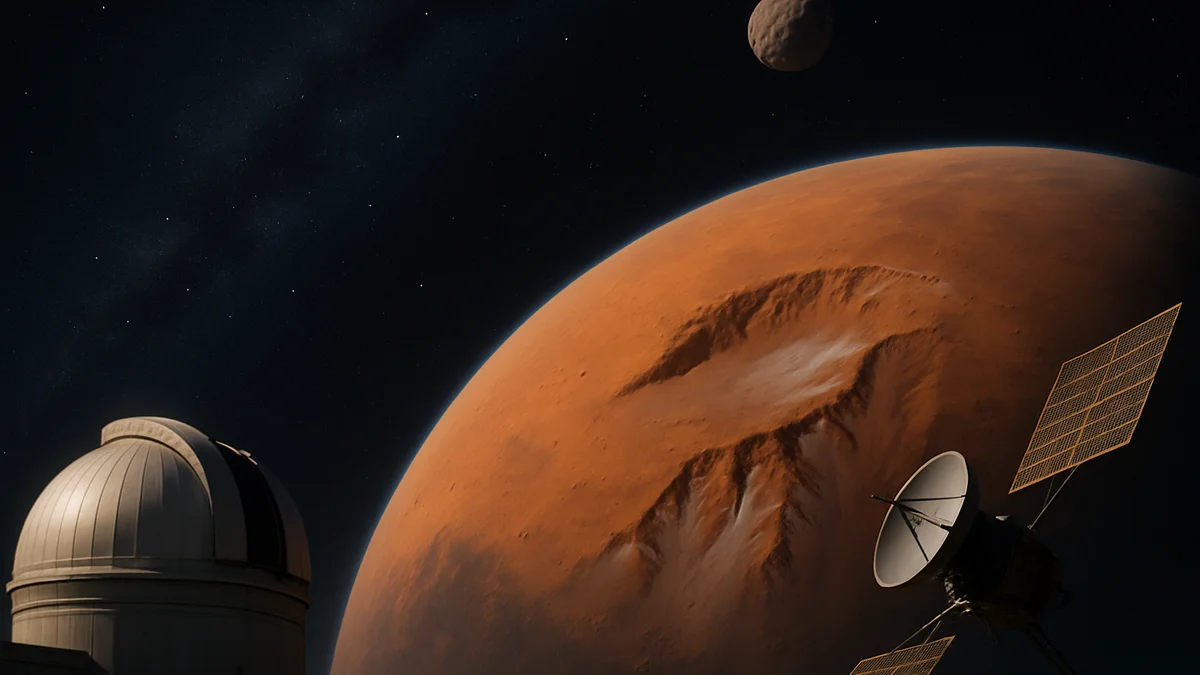
For years, the channels carved into Martian crater walls looked like a smoking gun for liquid water on the Red Planet. A report from Universe Today on September 11, 2026, revisits that question — and lands on a different culprit: frozen carbon dioxide, not water, is what keeps these gullies active today.
What exactly are Mars's gullies?
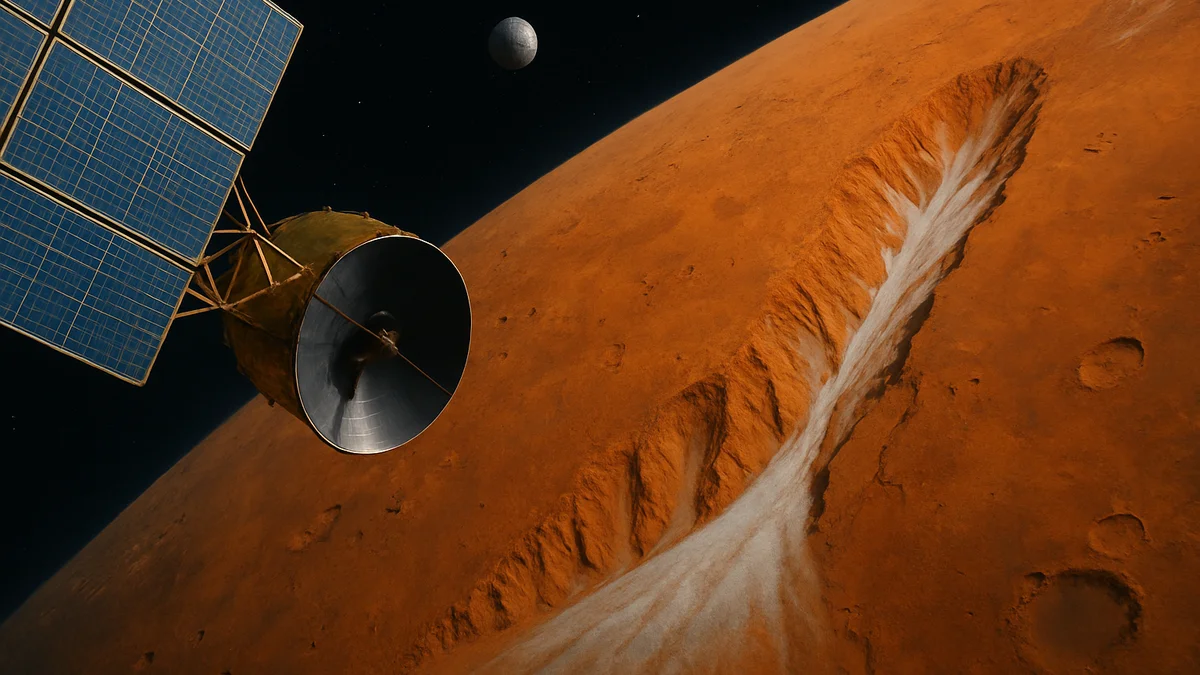
Gullies are a distinctive three-part landform first spotted on Mars in images from the late 1990s and early 2000s: a narrow alcove near the top of a slope, a channel running down the middle, and a fan-shaped apron of debris spread out at the bottom. They show up on steep terrain — crater walls, canyon sides, isolated hills — mostly at middle and high latitudes, in both hemispheres. To eyes trained on Earth's geology, the shape is unmistakable: it looks exactly like what a flash flood or a seeping spring leaves behind on a hillside.
Why water was the first suspect
That resemblance is exactly why early researchers proposed liquid water as the carving agent — either water melting from underground ice, or brine seeping out partway down the slope and gouging a channel as it ran downhill. It was an exciting idea, because liquid water is the single ingredient astrobiologists care about most. If something on Mars was still moving as water today, however briefly and however salty, it mattered enormously for the search for present-day habitable niches.
What actually changes on these slopes, and when
The problem for the water hypothesis is timing. Orbiters that have tracked the same gullies across multiple Martian years have caught them growing and changing not in the warmth of summer, but during the depths of winter and the start of spring — precisely when surface temperatures are far too cold for liquid water, salty or not, to survive even briefly. What does show up on those slopes every winter is a seasonal coating of frozen carbon dioxide — dry ice — that forms as the atmosphere itself freezes onto the cold ground. As spring sunlight returns, that frost doesn't melt the way water ice would; it sublimates, turning directly from solid to gas. That abrupt phase change can lift and destabilize the loose material underneath, sending debris sliding downslope and carving a channel, without a drop of liquid ever entering the picture.
Gullies aren't Mars's only "water mystery" to get rewritten
Gullies aren't the only slope feature that once looked like water and turned out to have a dry explanation. Recurring slope lineae — narrow, dark streaks that lengthen down sun-facing slopes near Mars's equator during the warmest part of the year — were proposed as evidence of seasonal salty water flows when they were first described. Closer study of how and where they form pointed instead to dry granular material sliding downhill, more like a slow-motion sand avalanche than a stream.
| Feature | First suspected cause | Better explanation now | Typical location | |---|---|---|---| | Gullies | Liquid water or brine seepage | CO2 frost sublimation | Steep slopes, mid-to-high latitudes | | Recurring slope lineae | Seasonal briny water flows | Dry granular (sand) avalanches | Sun-facing slopes near the equator |
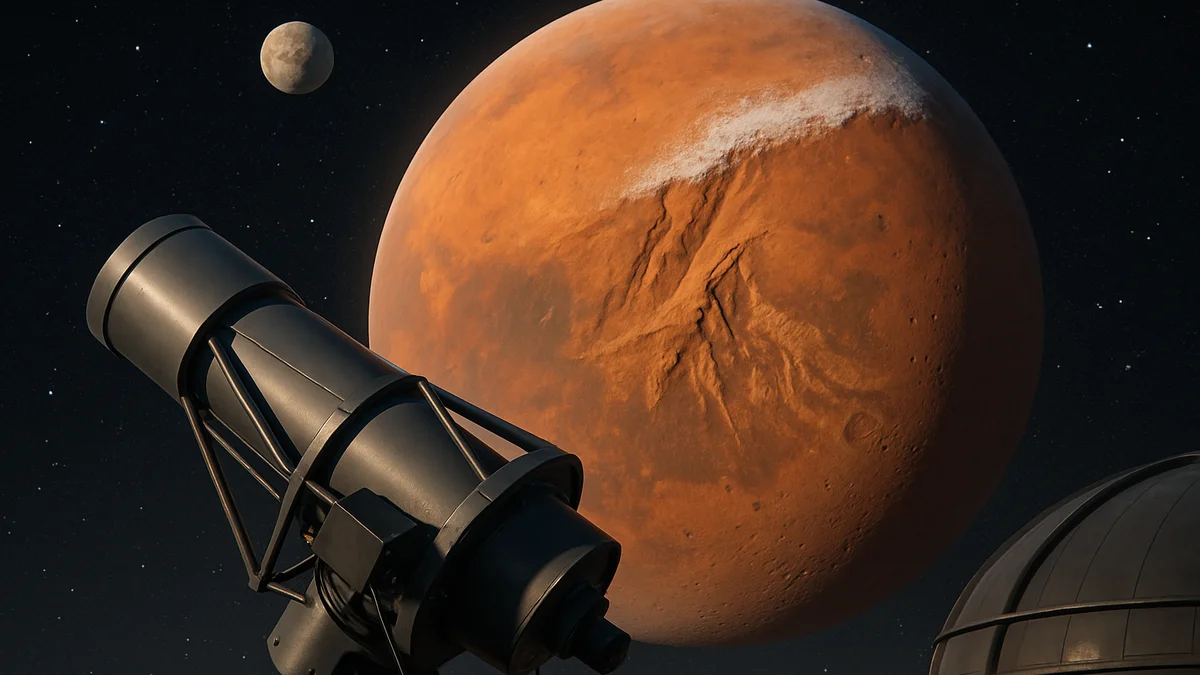
Two of Mars's most water-like looking surface features, in other words, both turned out to be driven by processes that never involve liquid water at all.
Why this still matters for the search for life
Ruling out liquid water as the engine behind gullies doesn't make Mars less interesting — it sharpens where to look next. If the surface's most dramatic, currently active landforms are explained by frozen CO2 and dry avalanches rather than flowing water, the search for present-day liquid water on Mars shifts underground, toward buried ice and any pockets that might stay warm and shielded from the surface's brutal seasonal swings.
Watch the season that drives it
The mechanism behind Mars's gullies is fundamentally seasonal, and Mars's seasons come from the same thing Earth's do: an axial tilt, at roughly 25 degrees, not too different from our own. On the real-time 3D simulator at Solar System Live, you can track Mars along its orbit and watch that tilt in action — a visual reminder that the frost cycle carving these gullies is tied directly to where Mars sits on its nearly two-Earth-year trip around the Sun.