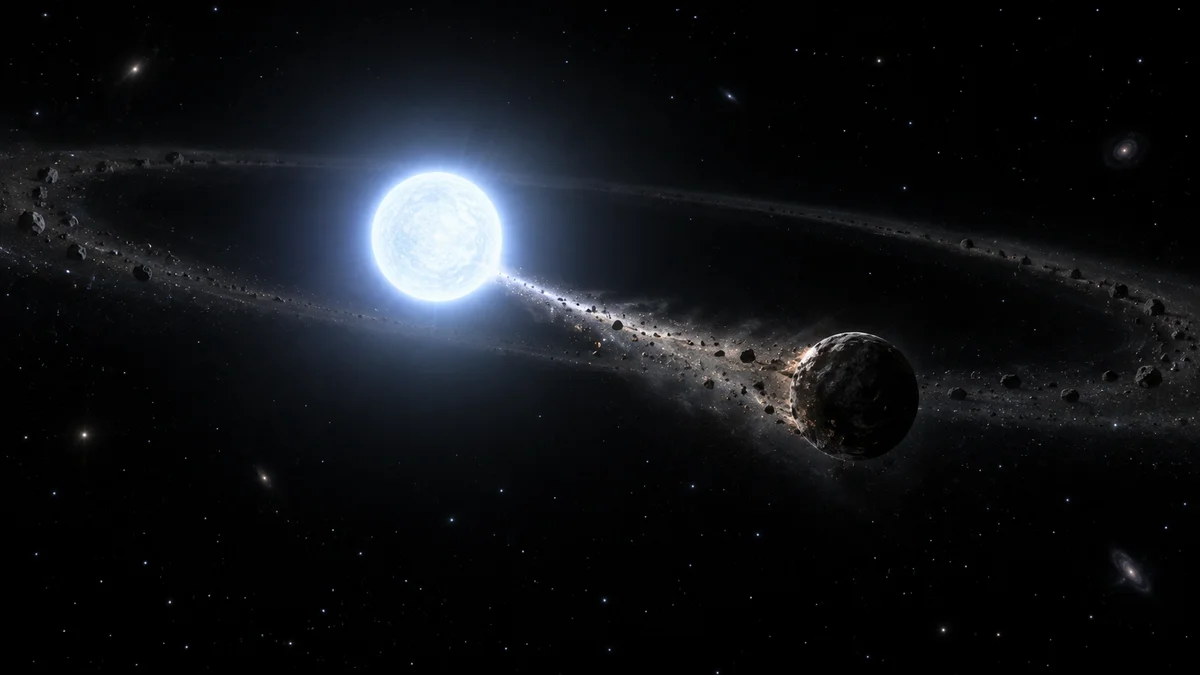
A second-generation planet would form from material expelled by a star late in its life, rather than from the cloud of leftovers surrounding a newborn star. Astronomers have found evidence for a possible example around the white dwarf HS 0209+0832—but the evidence is a chemical and brightness pattern, not a direct picture of a planet.
The useful question is how those clues fit together. The atmosphere of the white dwarf contains an unusual chemical signature, and observations also show a repeating brightness variation. Together, these findings support a planet candidate that may be losing material to the star. They do not yet amount to a photograph or a settled account of how the planet formed.
What does “second-generation planet” mean?
Planets in our Solar System formed from material left over from the Sun’s birth. A second-generation planet, by contrast, would form later, from matter cast off as its original star evolved and died. NASA describes HS 0209+0832 as a white dwarf: the remnant core of a low-mass star that has used up its nuclear fuel and shed its outer layers.
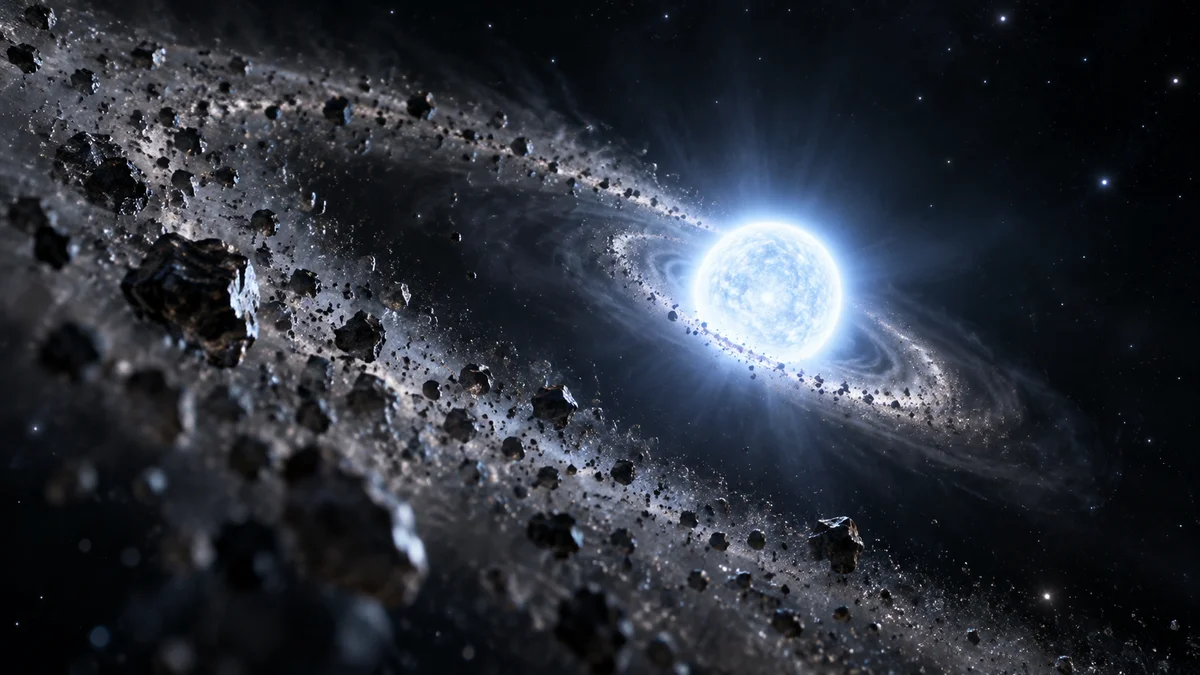
The distinction is about the material’s history, not the planet’s age relative to Earth. In this case, researchers propose that some enriched stellar material may have collected in a disk around the remnant and formed a planet. That is a possible pathway, not something directly seen happening.
| Clue reported by researchers | What it points toward | What it does not establish alone | |---|---|---| | Niobium and other heavy elements in the white dwarf’s atmosphere | Material unlike typical rocky planetary debris | The complete structure or history of a planet | | Very little silicon and no detected iron | A composition unlike familiar rocky bodies | That the source must be a planet | | A repeating brightness variation | A possible orbiting, evaporating giant planet | A direct image or definitive confirmation | | The proposed second-generation origin | Formation from material expelled by the dying star | Which formation pathway actually occurred |
Why is niobium such an important clue?
The research team re-examined old ultraviolet observations from Hubble and identified niobium among features that had previously been unidentified. The published study reports that HS 0209+0832 is enriched in elements including zinc, copper, and niobium, while traditional rock-forming elements such as silicon and iron are depleted.
The pattern matters because it differs from the composition expected for familiar Solar System material. The study argues that the combination is consistent with matter from a second-generation planet, formed from material ejected during the star’s giant phase. NASA’s account also explains the reasoning: niobium and other elements heavier than iron can be produced in the conditions associated with a dying star, making them a potential chemical fingerprint of that history.
A white dwarf’s atmosphere can preserve clues about material it is accreting. Here, the researchers interpret the unusual mixture as evidence of an external source feeding the star. That is why the claim is stronger than simply noticing an odd element—but it still depends on interpreting the composition, rather than observing a planet’s surface.
What is the repeating signal, and what remains uncertain?
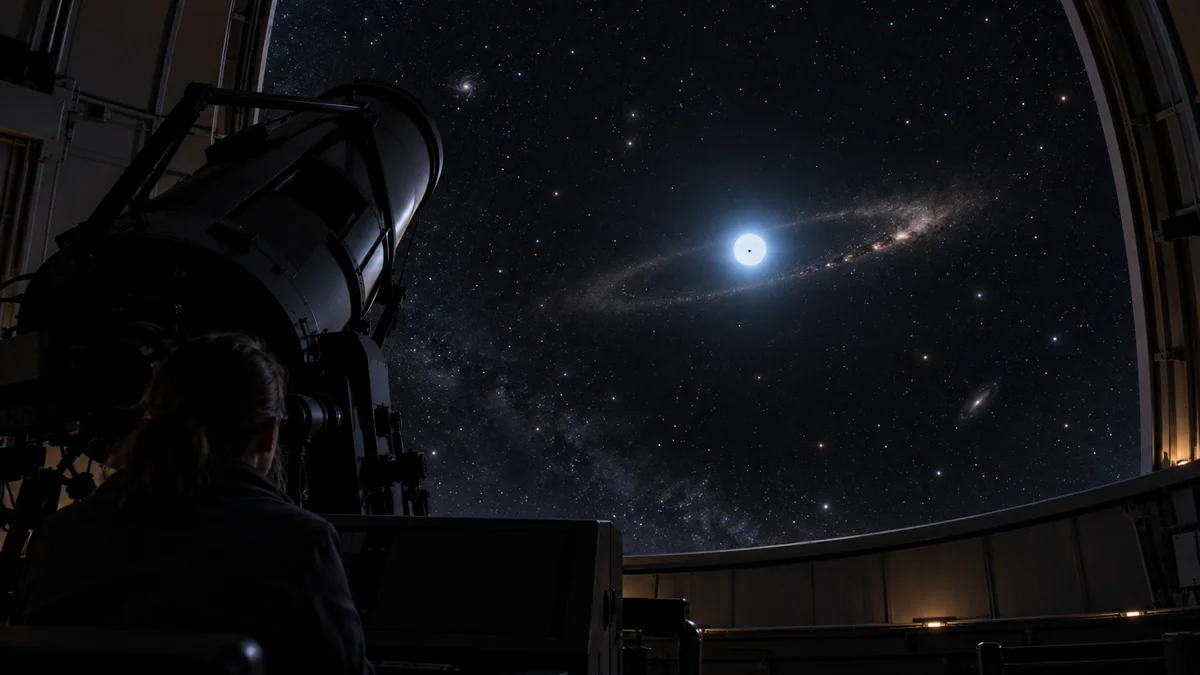
The study reports a repeating brightness variation with a period of about 4.4 days. The authors attribute it to either changing thermal emission as a planet’s day and night sides rotate into view, or to a transiting tail of material from an evaporating gas giant. NASA says observations by the TESS spacecraft over four months found periodic variations consistent with a planet orbiting close to the white dwarf.
That signal adds a second kind of evidence to the chemical fingerprint. The composition suggests what kind of material is being accreted; the repeating brightness change offers a possible clue to an orbiting object and its escaping atmosphere. Neither observation alone is a direct image. The published work presents the planet as a candidate, and the precise interpretation of the light variation remains open.
The researchers describe more than one possible formation route. A planet might have formed in a disk from expelled stellar material, or older planetary material might have interacted with that disk. The current clues support the broader second-generation possibility, but do not resolve every step in the system’s history.
What can a Solar System simulator show us here?
HS 0209+0832 is not part of our Solar System, and Solar System Live cannot display its white dwarf, planet candidate, or chemical measurements. The simulator is useful for a different comparison: the planets around our Sun belong to the first-generation family described by NASA, formed from material left over from the Sun’s birth.
That contrast makes the finding easier to frame. The question is not whether our planets will become this candidate; it is whether planetary formation can begin again around a stellar remnant. To explore the familiar first-generation example, open the planets in Solar System Live. Then compare that view with NASA’s explanation of the Hubble evidence and the study in Nature Astronomy. Keep the distinction clear: a chemical signature and a repeating signal make a compelling case to investigate, while confirmation and the planet’s formation history remain questions for further evidence.