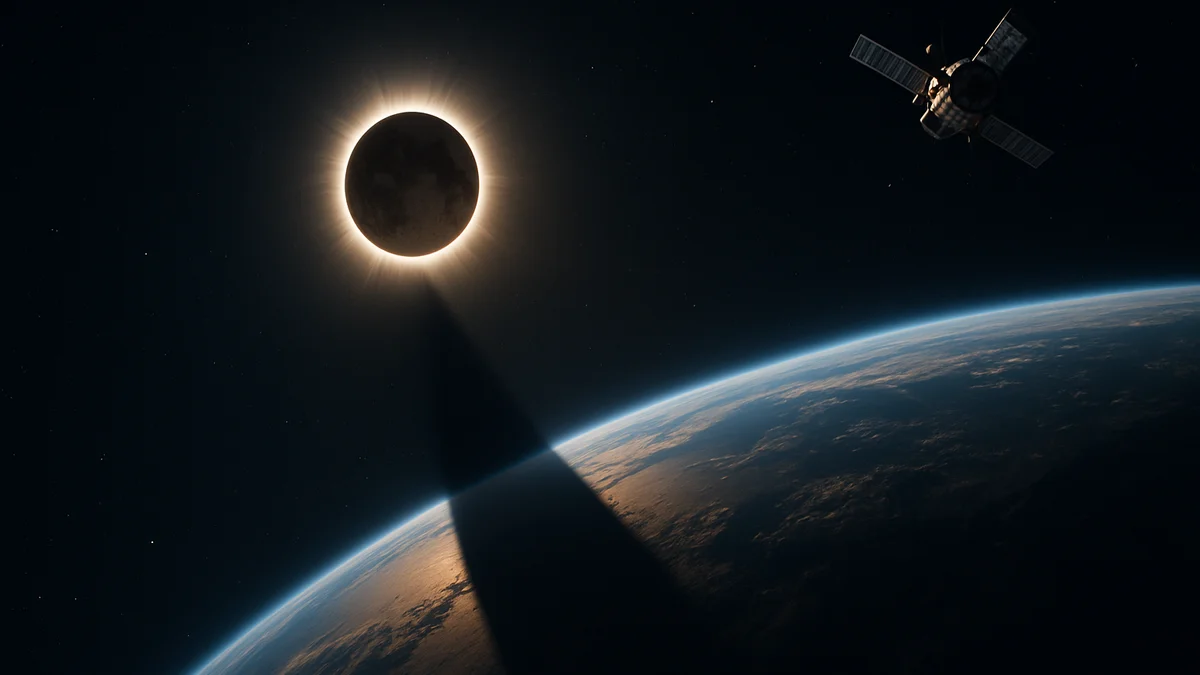
Every total solar eclipse produces something that looks almost wrong: a circular shadow, rarely more than a couple of hundred kilometers wide, sweeping across Earth's surface faster than the speed of sound. Eclipse chasers — people who board planes and cross continents specifically to stand inside that shadow for a few minutes — describe the experience as unlike anything else in nature. The NASA Astronomy Picture of the Day from September 5 captured exactly this pursuit: someone chasing the Moon's shadow across the planet.
What makes that shadow so narrow, so fast, and so rare is not a mystery. It is orbital geometry made visible.
Three shadows, one alignment
When the Moon passes directly between Earth and the Sun, it casts three distinct zones of shadow into space.
The umbra is the darkest cone, where the Sun is completely hidden. This is where a total solar eclipse happens. At Earth's surface, the umbra is narrow — rarely more than 270 km across, often much less. Anyone standing outside it sees only a partial eclipse at best.
The penumbra surrounds the umbra: a larger region where the Sun is only partially covered. Observers here see a partial eclipse, which can be striking, but lacks the defining feature of totality — the sudden darkness and the appearance of the solar corona.
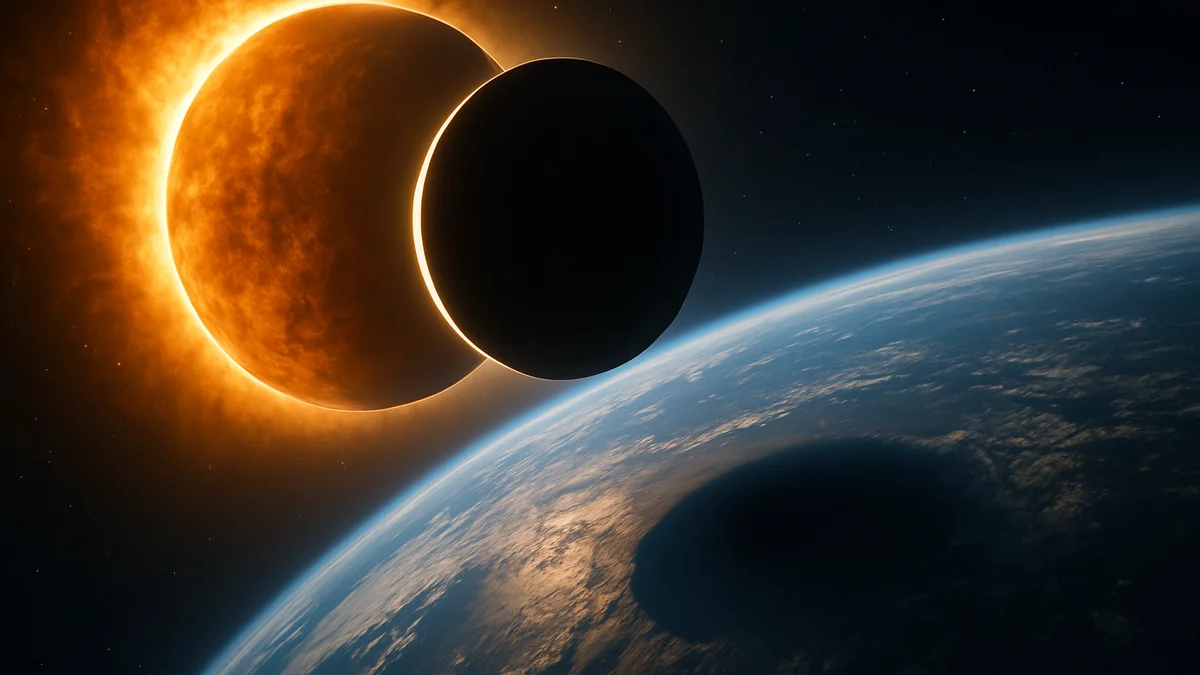
There is also an antumbra, the shadow that extends beyond the tip of the umbra cone. When the Moon is near apogee (its farthest point in its elliptical orbit), the umbra cone does not quite reach Earth's surface. The result is an annular eclipse — the famous "ring of fire" — where a thin circle of the Sun remains visible around the Moon's silhouette.
Why the shadow moves so fast
The Moon orbits Earth at roughly 1 kilometer per second. As it crosses the line between Earth and the Sun, its shadow sweeps across the ground at over 1,000 km/h — faster than a supersonic aircraft. This is why totality at any fixed location lasts only a few minutes: the shadow arrives, briefly swallows the Sun, and continues eastward following the Moon's orbital direction. Some expeditions have used specially routed aircraft to chase the shadow and extend those minutes. It is the only way to gain time against the geometry.
Why eclipses do not happen every month
A new moon occurs roughly every 29.5 days. If the Moon's orbit lay exactly in the same plane as Earth's orbit around the Sun, we would have a solar eclipse at every new moon. We do not — and the reason is the tilt.
The Moon's orbital plane is inclined about 5.1 degrees relative to Earth's orbital plane around the Sun (the ecliptic). Most new moons pass either above or below the Sun as seen from Earth. A solar eclipse only happens when a new moon falls near one of the two lunar nodes — the points where the Moon's orbit crosses the ecliptic. These crossings occur roughly twice a year, creating two brief eclipse seasons. Even then, a total eclipse only traces a narrow path; partial eclipses are far more common.
The coincidence that makes it possible
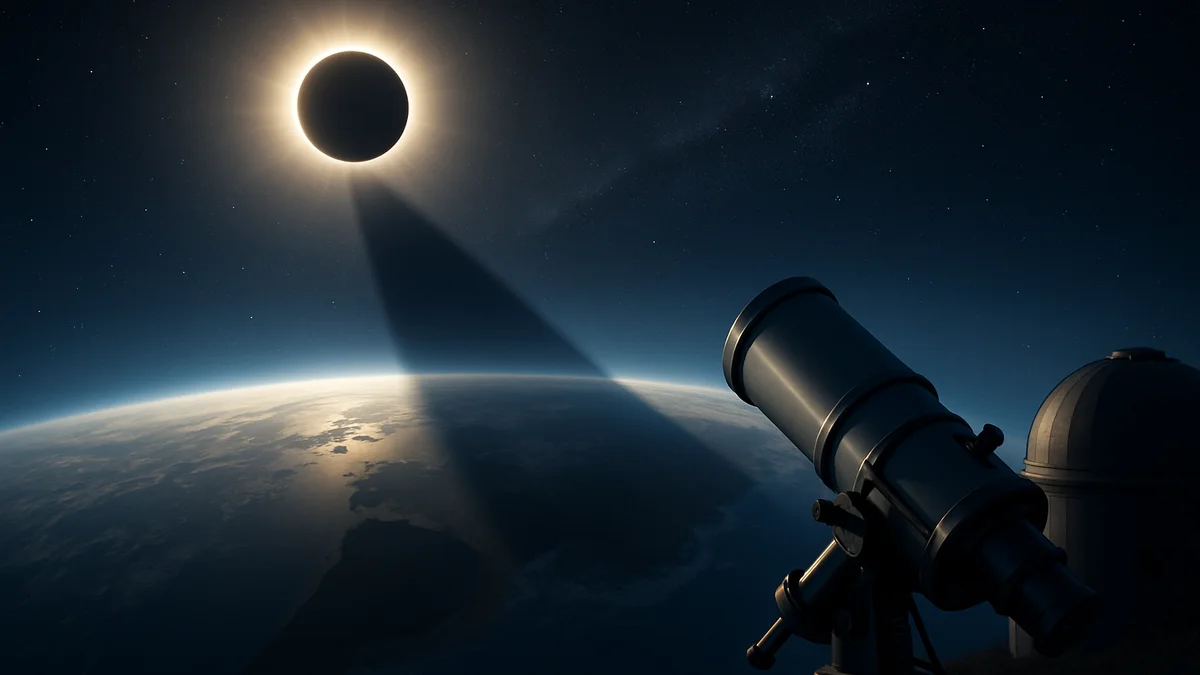
There is something in the geometry of a total solar eclipse that has no parallel elsewhere in the solar system: the Moon appears almost exactly the same angular size as the Sun when seen from Earth.
The Sun is roughly 400 times wider than the Moon. It is also roughly 400 times farther away. These two factors nearly cancel out, producing an apparent size match precise enough for the Moon to cover the solar disk almost completely. This is not a fixed coincidence — it shifts as the distances between Earth, Moon, and Sun vary, which is why the same alignment sometimes produces a total eclipse and sometimes an annular one. But it is close enough that, at the right moment, the Moon covers every bit of the Sun's bright surface while leaving the outer atmosphere, the corona, blazing around the edges in full view.
No other large moon in the solar system creates this effect for its planet. It is a coincidence of size and distance that, from where we stand, produces the most dramatic astronomical event visible with the naked eye.
See the geometry from outside
A photograph taken from inside the path of totality shows what the eclipse looks like. What it cannot show is why the shadow is so narrow, or why the alignment only happens at certain points in the Moon's orbit.
The real-time 3D simulator on Solar System Live shows the solar system from outside. During an eclipse, the alignment of Earth, Moon, and Sun becomes visible in space — you can see the Moon's shadow cone and understand immediately why the strip of totality on Earth's surface is so small relative to the planet's disk. The orbital inclination that keeps most new moons from producing an eclipse is visible too, as the Moon's path tilts slightly away from the ecliptic plane.
The geometry is always there. The shadow is just waiting for the right alignment to appear again.