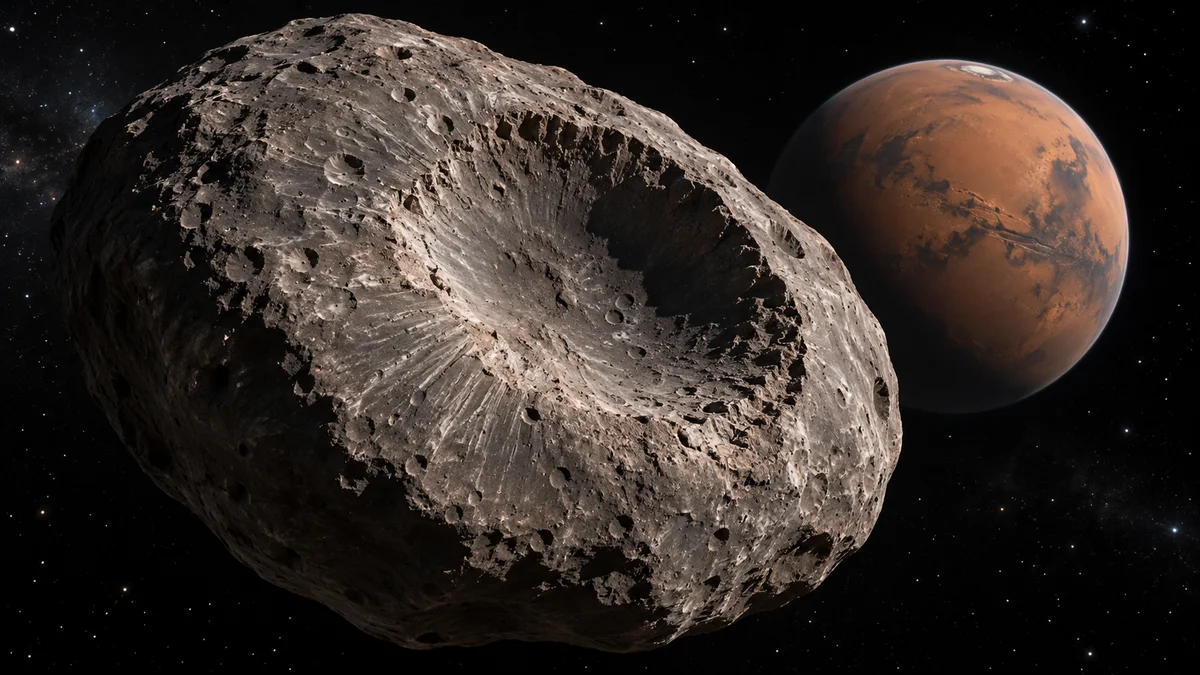
Stickney Crater is so large compared with Phobos that the impact which formed it may have come close to breaking the small Martian moon apart. The crater measures more than 9 kilometers across—nearly half the diameter of Phobos itself, according to NASA’s Astronomy Picture of the Day.
That scale is the key to reading the image. Stickney is not just a prominent mark on a distant moon: it is a way to think about how one impact can leave clues across an entire small world. The photograph also shows features whose origins remain uncertain, so the most useful tour separates what is visible from what scientists propose.
How big is Stickney Crater compared with Phobos?
NASA describes Stickney as the largest crater on Phobos and says it is over 9 kilometers across. Since that is nearly half the moon’s diameter, the comparison gives a sense of why the crater-forming impact is thought to have been so consequential. NASA says the impact likely came close to shattering Phobos.
| Feature in NASA’s description | What the source says | How to read it | |---|---|---| | Stickney Crater | The largest crater on Phobos | A dominant feature on the moon | | Crater width | More than 9 kilometers | A direct size estimate for Stickney | | Relative scale | Nearly half of Phobos’s diameter | The crater is enormous in relation to its host | | Impact’s possible effect | It likely came close to shattering Phobos | A qualified interpretation, not a claim that the moon broke apart |
The comparison is more informative than the crater’s width alone. A number tells us the feature’s span; the ratio to the moon gives us a sense of its scale. NASA’s wording also matters: the impact likely came close to shattering Phobos. The account does not say the moon actually broke apart.
What can we see in the image besides the crater?
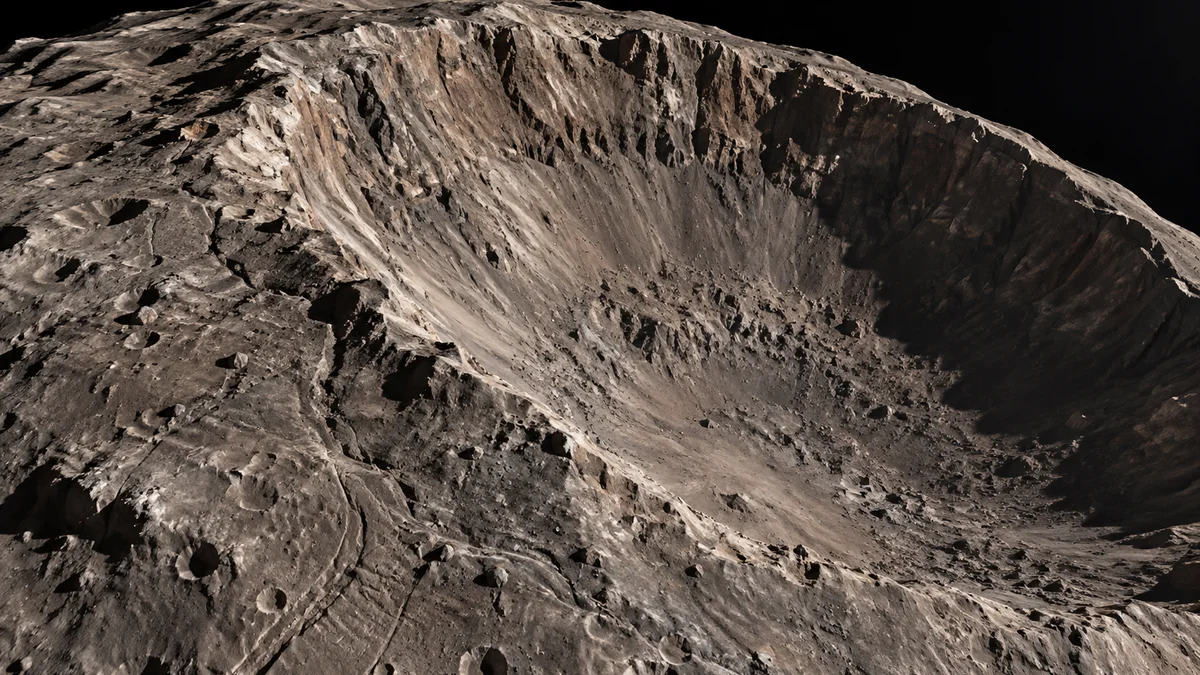
The image is an enhanced-color view of Stickney and its surroundings. NASA says it was recorded by the HiRISE camera aboard the Mars Reconnaissance Orbiter as the spacecraft passed within about 6,000 kilometers of Phobos in March 2008.
Look first at the crater and then at the streaks inside its walls. NASA says those streaks suggest that loose material slid down the walls over time. That is a reading of surface features, not a view of the movement happening as the photograph was taken.
Light bluish regions near the rim may indicate relatively fresh surface material exposed there. The wording is cautious: the color could point to a relatively fresh exposure. The image offers a clue to investigate, not a complete account of when or how that material came to be visible.
What are the grooves on Phobos, and why are they mysterious?
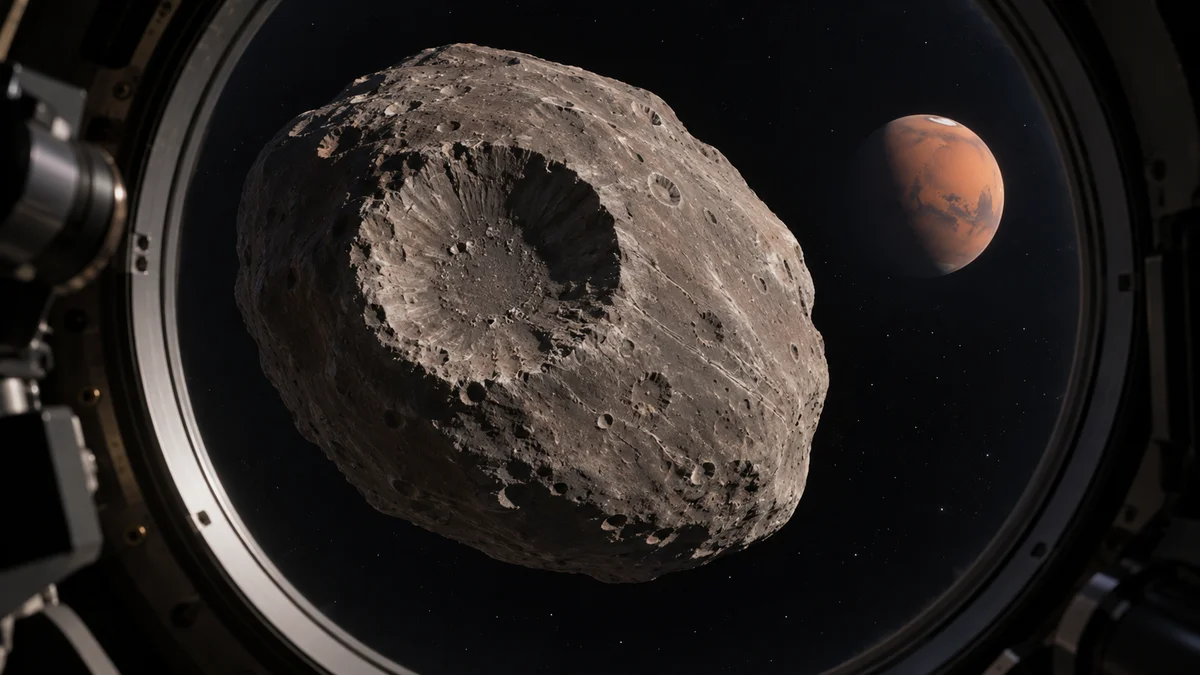
The surface around Stickney also has curious grooves. NASA says their origin is mysterious. One possibility is that they are related to tidal stresses experienced by Phobos as it orbits close to Mars; another is that they are connected to the impact that formed Stickney.
Those alternatives are useful because they show how one image can frame competing explanations. The grooves are visible features; their cause is not settled by the photograph or by the brief APOD description. The careful takeaway is not that one proposed cause has been proven, but that researchers have more than one possible connection to examine.
What does this image teach us about Phobos?
The image brings together a moon, a dramatic crater, and smaller clues in the surrounding terrain. The crater’s relative size makes the possible force of the impact easier to imagine. The streaks point to material that may have moved down the walls, while the color near the rim and the grooves invite questions that the image alone cannot answer.
Phobos is one of Mars’s moons, so Solar System Live can help place Mars in context among the planets. The simulator does not show the crater’s surface detail. For that, open NASA’s Stickney image and explanation. Start with the crater’s scale, then trace the streaks and grooves, keeping each proposed explanation at the level of certainty NASA gives it.